In Three Words

Here we are then, in the UK Silly Season. Although it could be argued that we’ve been suffering that particular season since June 2016. But wait. I have always maintained not to get political on this blog, although sometimes it is hard not to rant, rave, scream, stamp and generally be a big mouth about SomethingorOther. So many causes out there to support; so many injustices and hurts to rail against. Where to start, eh? But as I say, No. This is meant to be a writer-related blog although it can be hard sometimes to say anything that a) anyone wants to read, b) that hasn’t been said before or c) isn’t just plain boring. So then dear Reader, what approach shall we take today?

Well, for starters, how about a visit to The Houses of Parliament? Ever been there?


 Let’s play the Three Word Game ie – Describe yourself in 3 words – ‘Witty’ ‘Bold’ and ‘Waggish’ for example – except apply to a recent visit, meeting or coincidence.

So back to the Houses of P. Three Words.
1)Weird
2) Tiny!
3) Perplexing

A Meeting:
1) Chance
2) Surprise
3) Hot

and a recent coincidence
1) Unsettling
2) Profound
3) Bewildering

And now apply the same rules to that short story/flash fiction/novella you’re busy crafting through these summer months. In essence, what are you writing and What Is It About? Use the three point plan to answer yourself. Describe what you’re writing in three words. Then describe what you’ve written in three words. Does it add up to six? If not, maybe go back to the notepad.
Whilst wandering the corridors of power inWestminster yesterday I was hoping the sandwich of inspiration would land in my mouth and fill me with lots of amazing and creative ideas stuffing me to over-full with plans and thoughts for the next blockbuster. All I could come up with was a Steampunk Romance in an alternative universe.
danilo-d-agostino-TmSaH54lLG4-unsplash.jpg

Perhaps I need a holiday.


photo by
Danilo D’Agostino

Meeting Mike Gayle

On Wednesday I was lucky enough to be the in the audience for an evening of author talk with the very open and interesting multi-novellist author Mike Gayle, his editor Nick Sayers of Hodder and Stoughton, hosted by independent book shop Kenilworth Books which is based in Warwickshire, slap bang in the heart of the UK.
If you haven’t been to one yet but get the chance to attend an evening where an author talks about their process, their history, their long journey to publication, then I thoroughly encourage you to go. One of the most useful nuggets we came away with was the need for planning. No, not the sort of planning that involves three cups of coffee, a cuddle with the cat and a wander outside for ‘a bit of fresh air’ with a notebook doing absolutely nothing, but the sort of proper planning that involves – and get this wannabe authors – writing a two line synopsis for every chapter of your book. My friend said to me afterward of a masterpiece she is working on ‘that’ll be why I haven’t finished my book – I have no idea what’s going on.’
I’ve never thought about doing a chapter by chapter synopsis. I’ve done actual planning for an entire novel only to find the end result is nothing like I’d thought – nay planned – it would be. Odd how that happens. One person asked about ‘the muse’; does it ever strike? No, was Mr. Gayle’s definite answer. For muse read procrastination. True. But what if you’re not in the creative zone busy carving out characters that live in a whole new world created by you? Short answer – edit. Stop being all arty farty and get brutal instead. Get out your scalpel and trim trim trim trim. And I don’t mean your beard, my furry faced friend. Amputate your adjectives and ditch those descriptors! Squeeze out the fat and get to the muscle beneath, and when you’ve done that, you may see the bare bones of the story (I’m sensing a theme here…). It’s good to edit. But then of course, you have to know how to. There’s a big difference between changing your mind about something you’ve written ‘I don’t like that bit. I’ll change his jumper to blue’ and proper editing. How about not mentioning the jumper at all? Chekov’s Gun and all that. And that of course is where Nick Sayers’ insight was invaluable. How do you know what even needs editing? someone asked. Well, ‘you just do’, was the answer. Clunky dialogue, confusing/boring/pointless sentences/paragraphs/chapters will stand out to an expert, which is why they are experts at what they do. Midwives, really, helping the author deliver what the author thinks they want to deliver; what they had planned in those two-line chapter by chapter synopses.
And talking of which – I sent off some work to a very well known agency recently:
‘send both synopsis and the first 3000 words of your novel in one document only.’ Well that’s easy enough. I can do that. Edited the work in question, added it to the same document as the pain-stakingly created, written, revised, rewritten 3 page synopsis and pressed send. God they’ll think I’m brilliant.
And then I saw that little teeny weeny bit that said ‘send a synopsis of no more than a page…’

Should have edited properly, shouldn’t I.

Six Things I Learned About Blogging

Here’s a GREAT 6-pointer reblogged to help focus the mind to help smarten-up and sharpen-up your blogging. I had never considered point number 4; perhaps I should! Thanks for this R Michael. Let’s have some more!

Ryan's avatarR&H Collectibles

  1. Consistency

If you aren’t regularly posting content, at least a few times per week, then it will be easier for your work to get drowned out by other voices.  Regularly posting helps your SEO.  It shows the internet that you are invested and care too.  If you post once per month it will become easy for people to forget about you.  It may not be fair, but it is a reality all of us writers need to come to grips with.  Once I started posting daily content, I noticed a significant increase in readership opposed to a few years ago when I would blog when inspiration came my way. Consistency is important for any medium for producing content on the internet.

  1. Quality Content

So, you post every day, but still no one reads your stuff.  Maybe then it’s time to look at WHAT you post.  Someone online complained to me…

View original post 357 more words

Five Tips on Writing Characters

Having a bit of a blank when it comes to writing a character? Can’t quite get into their head? Worry not. It’s easy peasy lemon squeezy really. By using one of your best writer’s skills – Observation – you’ll see your characters are all around, fully formed and perfect for harvesting. Reading The Metro recently I was delighted to find five fully-formed characters staring at me from the page, ready to be gathered together like spring flowers and plopped into a novel. Let me share them with you:

Shy Blonde In Red Coat
Very Shy Girl
Brunette With Light Blue Eyes
Rachel The Sleepy Blonde
and my absolute favourite,
The Sweaty Guy With A Runny Nose.

All these are love-lorn commuters looking for love through The Metro’s Rush Hour Crush. So, a sweaty guy with a runny nose. Sounds better than Plague Victim I guess, but what a base to build a character on. Had he been running in cold weather? Or was he ill? On drugs maybe? Blond or bald?  For Shy Blonde read Assassin for sure, and Brunette with light blue eyes – well, not necessarily a woman is it?

Another place to find a character, even if you’re not especially looking for one, is at an event. Last week I was at a Jaguar Car Heritage Day at Blenheim Palace – not my usual entertainment for a Sunday but it’s good to do something you wouldn’t naturally do – and there he was. The Character I had a name for but not an appearance. I have a character that is not a nice person, but I didn’t want him to be a characterisation of a bad person – he has to be real. And there he was, right in front of me.

Picture the scene: millions of pounds worth of vintage cars, polished and buffed to within an inch of their historic automotive lives, surrounded by fans and enthusiasts – mainly dressed in beige slacks and leather shoes or designer jeans and trainers – when into my view swaggered a cigarette smoking man of about 45. Hair still dark, long to his collar and in which he’s parked his sunglasses, designer jeans – but with the hems trodden down at the back, scruffy around the pockets, wearing a jacket that didn’t match nor fit especially well and fraying slightly on one sleeve. He loped around a few of the cars, dropped his shades over his eyes and stood against a low wall for a while. He seemed distracted – he could have been waiting for a bus – but I knew straight away he was the character in my next short story. Gotcha. See – easy peasy lemon squeezy.

How To Make Them Real:

1 Observation. Always. Look closely, if you can; observe the shoes, the hair, the hands that serve you that coffee.
2 Short snippets in newspapers or online. The small bits that are used for fillers are often the gold nuggets where you’ll discover your characters
3 Amalgamation Jigsaws. Take the best of worst of lots of people you know or are in contact with. Squish ‘em together, make a character. I call this my Frankenstein Character – they don’t all turn out to be monsters!
4 Animals. This way of creating a character is usually done when the moon is full and the creative juices have gone off-piste for a bit, but you can have a lot of fun doing it. Old dog, limps slightly due to hip trouble, a bit deaf, square hairy face, independent spirit,
or,
Old man, limps slightly due to hip trouble, a bit deaf, square hairy face, independent spirit. You get the idea.
5 Start with the name. A woman called Star, for example. What would she do? Singer? Librarian? Full-time Mum? Make a list – I love excel for this* – create names in one column, profession/job/life direction in another. Match up as your instinct tells you. Then ignore that instinct and match up differently. Maybe Colin in Accounts becomes Colin the professional tennis player by day and drag queen by night. Up to you. 

Try this fella for size…andrii-podilnyk-1060018-unsplash.jpg

photo by Andrii Podilnyk
on Unsplash


*note to self. Out. More. Get.

It’s Festival Time Again!

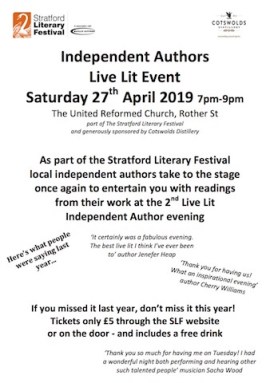
Great news for local self-publishers in the Midlands – we’re off to the Stratford Literary Festival again to read and promote our work and this time to a paying audience! Last year’s inaugural event was an absolute blast, and we’re delighted to be asked back again this year. So much talent!

Live Lit.jpg

The self-publishing world has grown and developed at such speed at times it’s hard to keep up. There are many different platforms to enable and encourage writers and a tremendous support network too. From writers’ groups, to open mics, to book festivals and creative writing workshops, there has never been more on offer – all helping to develop and improve the self-publishing experience and product. As a lover of books and reading, I support all endeavours to get our books out there – digital or paper – whether through the traditional agent/publisher route or your own self-ploughed route.

This year’s event is peppered with poets, including the Warwickshire Young Poet Laureate, Hannah Owens who we are delighted to have on board. Prose writers, short storyers (new word!) and open mic old hands will be entertaining us for two hours on Saturday 27th April from 7pm. 

Only five quid on the door and you get a free gin and tonic! (non gin-based enjoyments will also be available). So if you’re in Stratford upon Avon on Saturday you’ll find us at the United Reformed Church on Rother Street – you can’t miss it – and most likely with a SLF banner flapping in the breeze to welcome you in.

Wolf

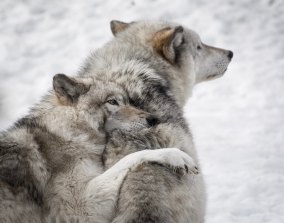
What is it about the word ‘wolf’ that conjures up so much mischief? Hilary Mantel’s book Wolf Hall has, in my humble, one of the best titles for a book ever. Yes I know she didn’t make up the title – who but the Tudors would name their homes so? Houses of the nineteenth and twentieth centuries were bestowed more pastoral names such as Sunnyside, Rose Cottage, Orchard View; no lupine references there to warn any visitor ofyannick-menard-1272925-unsplash the ambience of the place. Forget entering the lion’s den – the mere assonance of the words wolf and hall tells you all you need to know. In literature, as we know, the wolf has done a marvellous job securing a place in folklore – whether for good or ill – there’s the favourite, little red and all her trials and traumas; that sneaky double-dealer the wolf in sheep’s clothing, Peter and his wolf, which has a sort of nice ending – the wolf doesn’t end up brown bread, but he is wolfnapped and put behind bars in a zoo. Then there’re those house-building pigs and their nuisance neighbour who wanted to puff their properties down, and indeed, thanks to Aesop, the attention-seeking little boy who couldn’t help himself and kept crying ‘wolf!’ until one day there really was a wolf and…well…we all know what happened then, plus any number of other wolfie-related stories, sayings and poems littered through history and literature. ‘Holding the wolf by the ears’ is a great metaphor for things being a bit tricky, and keeping ‘the wolf from the door’ has a delicious medieval ring to it, sounding much better than ‘too much month left at the end of the pay packet’. The most up to date wolf story I found this week (although it may well be old news by the time you’re reading it) is about the young wolf who got himself stuck in a freezing river but thankfully was rescued. Except the rescuers didn’t know what they were rescuing – imagine being in a car with a cold and grumpy wolf across your lap, taking the scenic route to the vet. Dodgy. But it is a heartwarming story, so here it is, courtesy of the BBC.

The wonderful photo above is by Yannick Menard, freely published on Unsplash. Thank you Mr Menard
@yannickmenard

https://www.bbc.co.uk/news/world-europe-47330924

And now a poem by Richard Edwards
taken from
The Thing That Mattered Most: Scottish Poems for Children
edited by Julie Johnstone (SPL/B&W, 2006)

A Wolf In The Park

Is there a wolf,
A wolf in the park,
A wolf who wakes when the night gets dark?
Is there a wolf in the park?

Is there a wolf,
A wolf who creeps
From his hidden den while the city sleeps?
Is there a wolf in the park?

Is there a wolf,
Whose nightly track
Circles the park fence, zigzags back?
Is there a wolf in the park?

Is there a wolf,
Who pads his way
Between the tables of the closed café,
Is there a wolf in the park?

Is there a wolf,
A wolf whose bite
Left those feathers by the pond last night,
Is there a wolf in the park?

Is there a wolf?
No one knows,
But I’ve heard a howl when the full moon glows…
Is there a wolf in the park?