7 Tips for Clever Writing

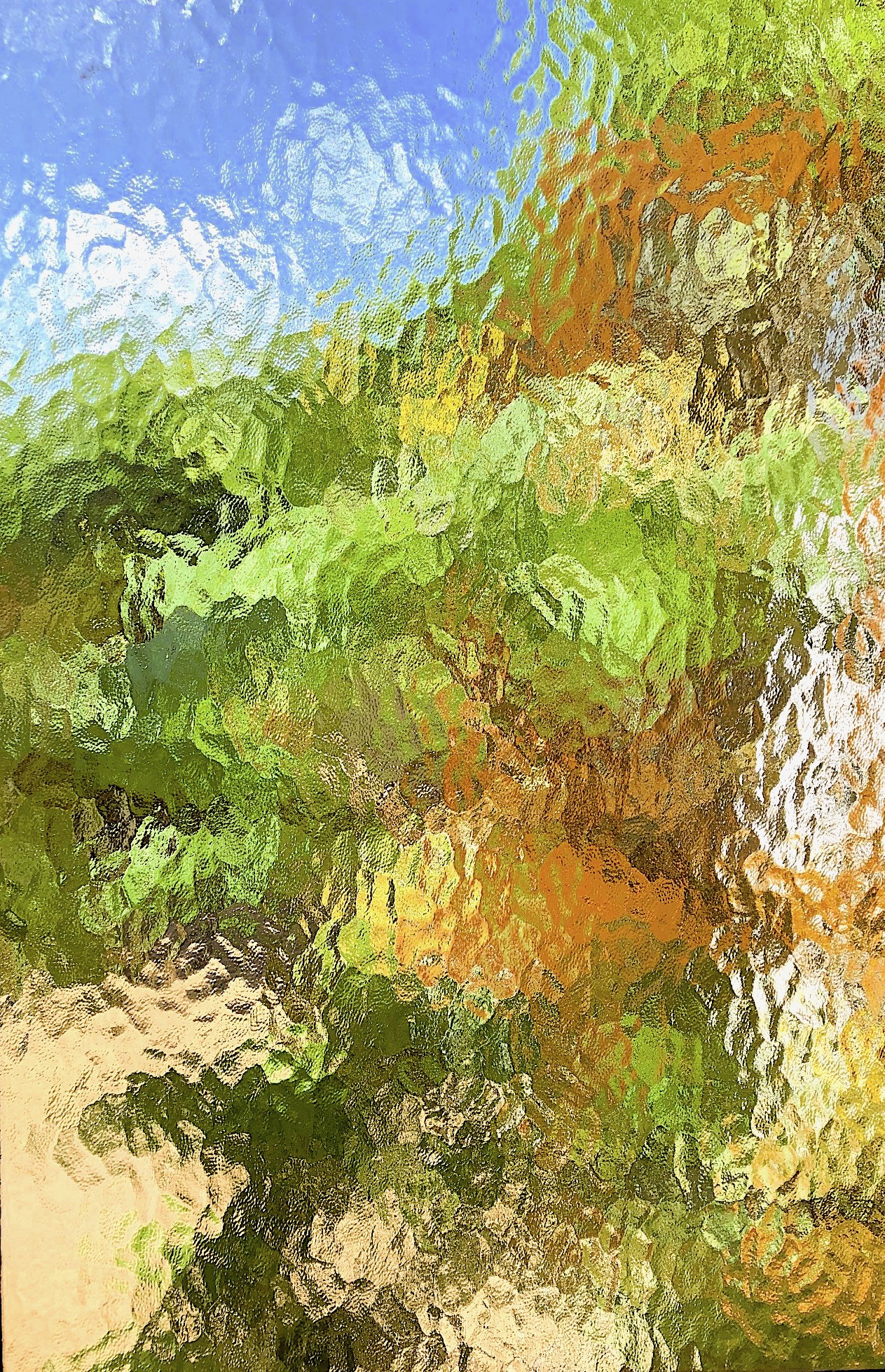
A few blogs back I wrote about being inspired by art. Well, with that in mind, I painted this picture to give vent to my lack of artistic talent. Like it? Not bad is it. I like the way the lines all merge together in a conclusion of colour that burst from the screen.

Confession time.

It’s a photo. It’s a photo of the sky and some plants taken through a wibbly wobbly window but it looks ok doesn’t it! Think you’re looking at one thing, but really you’re looking at another. That’s the trick. Now turn that into clever writing.

What do I mean by clever writing? What even is that?! Do I even know?

I guess I mean presenting the reader at the beginning with what they think is one thing but by the time they get to the end realise it’s a different thing altogether – but in a good way. Isn’t that what they call a Twist? Or Plot? Or maybe even a Plot Twist?

So here’re a few tips for you, should be you interested. Just my thoughts and observations… nothing too taxing. Let me know if you agree…or not

  1. Do your research then write like you haven’t. Eh? Wha..? As in, make your story so natural that your readers are drawn in straight away, without any time to argue the toss or disagree with what you’ve written. Make sure you know what you’re writing about in terms of exposition, especially in historic fiction.
  2. Writing science fiction? Make your new world as relatable as this old one and your readers will be there from the get-go. With time and good pacing of chapters you can unfold your new world without anyone really noticing and then bam – they’re residents of your new world without even booking a removal van.
  3. Without doubt clever dialogue is the way forward. What is clever dialogue? Is it what you hear all around, every day? Or is it well structured, over-long and completely unlikely? Do we speak now as Mr Darcy spoke then? Be brief. Be bright. Be Clever. If in doubt, chuck it out.
  4. Nab yourself a clever idea which will grow into your story giving rise to a great plot. Clever idea huh? Well excuse me while I just pop down to the clever plot shop. Simple’s always best. Make it too complicated – too many brush strokes – and you’ll lose your reader. Say for example you’re writing a cli-fi, how about the seas suddenly freezing over rather than warming up? Oh Contraire I hear you gasp.  It’s a 180 to the current crisis, so why not?
  5. Characters always help in a story, don’t you think? Making them mad a genius or an astronaut lost in space s a bit too clever – you’d have to know a lot about geniuses or space to pull that one off effectively. Nah, go clever. Writing crime? Police procedure? Let’s have no more of the grizzled-nearly-sacked-maverick-cop with a penchant for late night whiskey, but something cleverer. A deaf detective? Could be interesting.
  6. Develop a good support cast. Could be a horse. Could be a kid. Could be an older gent or lady with a secret past. Make your support characters shine.
  7. Read. Read other authors; work out why you like what they write. Read authors you’ve never heard of in genres you’d never normally consider. Give it a go, and be clever about it. Obvs.

Vincent van Gogh and Experimental Writing

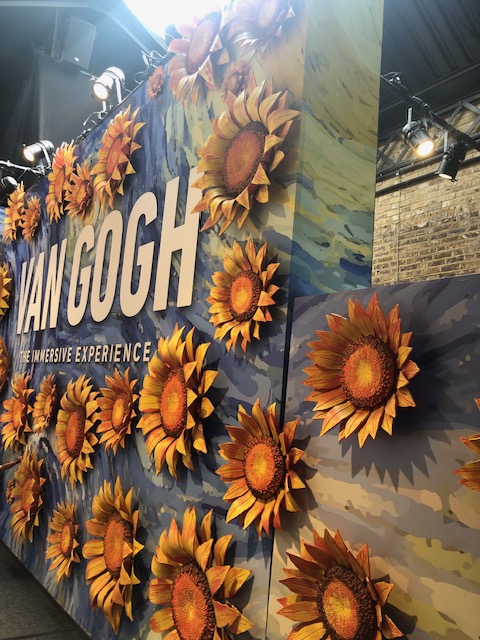
As you may have seen on a Twitter post from me recently I was lucky enough to visit the Vincent van Gogh Immersive Experience in Shoreditch and see for myself what all the excitement was about. And exciting it was.

I can’t honestly say I’m a fangirl of ol’ Vincent’s, but I do love a bit of art. Any art. The exhibition covered his life and premature death, his friendship with artist Paul Gauguin and the love of his brother. Did you know van Gogh originally wanted to be a priest? Me neither. You could say lucky for us that he failed in that respect.

The use of colour in Gogh’s work has often been discussed by those who discuss such things, and reading from the information sheets at the exhibition it seems that the conclusion drawn is that van Gogh may have suffered from xanthopsia, a condition which causes the sufferer to see in yellow more than any other colour. It’s not until you see so many of his hundreds of paintings together that you realise how much he loved his yellow. Think you know his sunflowers? Think again! He painted over 500 images of sunflowers, some of which you’ve probably never seen or even knew existed. It’s those big blousy ones in the vase that get all the attention. Drama queens.

Much of his work seemed to my untrained eyes very experimental – but then I’m no artist so what do I know – but according to the exhibition he had been told by one who knew so little, not to bother painting. He ignored such ill-founded advice and forged ahead.

Many of his preliminary sketches were on display and they put me in mind of a writer producing that scrappy first draft – you know the one – all puff and fluff, ideas and inspiration rather than proper prose and sentence structure.

How many times have you started with the puff and fluff, the idea and inspiration, to get fifteen minutes in declare it rubbish? That is not the way ahead my friend. Keep your puff and fluff, it could reap fantastic rewards a few months from now, because amongst the puff is the kernel of an idea that you had, and that must have some merit. Just because your whole story/novel/poem/essay isn’t formed yet doesn’t make it valueless.

Don’t be put off by that little niggly voice in your head telling you that what you’re writing isn’t any good. It might not be perfect – yet – but take a page off of Vincent’s canvas and stick with it.

Writing Competitions

Fancy having a go? Writing comps are a great way to hone your work, use a different voice, try something new, test yourself – 100 word flash anyone?! I’ve rounded up a few here for your delectation. Don’t forget to check the rules – some won’t take stuff already published online for example – and go for it. Everyone loves to win!

Closing on June 30th is the  South Warwickshire Creative Writing Competition Only £3 to enter with a £50 prize in each category, they’re looking for 800 words of fiction, creative non-fiction or 40 lines of poetry, all genres accepted. Still time to get your entry in.

Here’s a free comp to enter, closing date also 30th June. The annual Writers College Short Story Competition is held to acknowledge excellence in creative writing in the short story form. The competition is open to any writer who is unpublished, or has been published fewer than four times. The competition is open the writers just beginning their writing journey. The 2023 theme is ‘Words Have Consequences.’

The Creative Ink Writing Short Story Competition 2023 is open to writers across the globe until July 31st 2023 at 4pm (GMT). Stories do not need to follow any particular theme or genre, but must be written in English. Maximum word count is 3000 words. 1st prize: £1000, plus a free creative writing course of the winner’s choice and publication on their site. 2 runners-up: £200 each. Entry fee: £9.

If you like a bit of flash, try Free Flash Fiction Write, edit and submit by 10 pm Friday 23rd June 2023 a flash fiction piece of between 100 and 300 words, on any theme. 1x Winner will receive £150.00 and publication, 2x Highly Commended will receive £30.00 and publication, 2x Shortlisted will receive £20.00 and publication 
£3.75 fee per entry/story via PayPal or Stripe, £2.25 fee per entry/story via BACS (click here) (UK Bank accounts only ). 

Here’s something a little unusual, or maybe not. If you like witches, then this one’s for you. A Coven of Witches is the next anthology from West Avenue Publishing and this is your chance to have your work included. All submissions must include witches, or a witch, as the main theme of the piece. Each author may submit up to three pieces for consideration. They accept short stories of up to 5,000 words and poetry of any length. Please email your submission as a Word document to westavenuepublishing@outlook.com Submissions will close at midnight GMT on the 30th of June 2023. The list of successful authors will be published on their website no later than 31st of July 2023, so please do keep an eye out. Successful writers will receive a one off payment of £10. Writers will retain all copyrights for their submission/s.

She Said, He Said…

Overheard in a supermarket recently;

‘..so I told him straight, I wasn’t putting it anywhere near him…’

Fret not dear reader, I resisted the urge the hurl my trolley round the corner and follow the orator stealthily through the salad aisle in the hope of discovering what it was she wasn’t going to put anywhere near him, but I can tell you, the urge was incredibly strong. Instead, I distracted myself with the lack of cucumbers and pondered instead on what she could possibly have been talking about and how I could fit it into a short story. Was she reassuring him that she wasn’t putting the crocodile/the broken bottle/it anywhere near him, or was she refusing to put the crocodile/broken bottle/it anywhere near him? Alas it will always be a mystery to me as she disappeared down the cheese aisle still chatting on her phone and by the time I caught up with her in the bread aisle the call was complete. I had no way of knowing. Her poker face offered nothing. Brown or white bread seemed to be her only concern.  We parted ways in the rice and bean aisle and by the time I got to the wine aisle a story had formed.  The next hurdle was remembering it without writing it down.  Well you can imagine what the outcome of that was.

Needless to say I returned to my office later that day and set about dismembering my 500 word short story which has been slowly growing and transmogrifying into a completely different story to the one I originally started writing. Gone were two of the main characters and in their place was a soldier and a man who might turn into a milkman at any given moment. I think I may have lost the plot temporarily. I was keen, you see, to implant, somewhere, my newly over-heard dialogue. The fact that it didn’t fit in to any of the story didn’t faze me. It should have done of course as I wasted another two and half hours trying to insert a sentence into a story that had about as much right to be there as a spider in a fridge.

You can imagine how it all ended. The short story was re-written for the 110th time and the sentence only made it as far as this blog. Well, as a fan of recycling and reusing, I can’t see any problem with that. But even so, I wish I knew what she’d been talking about…

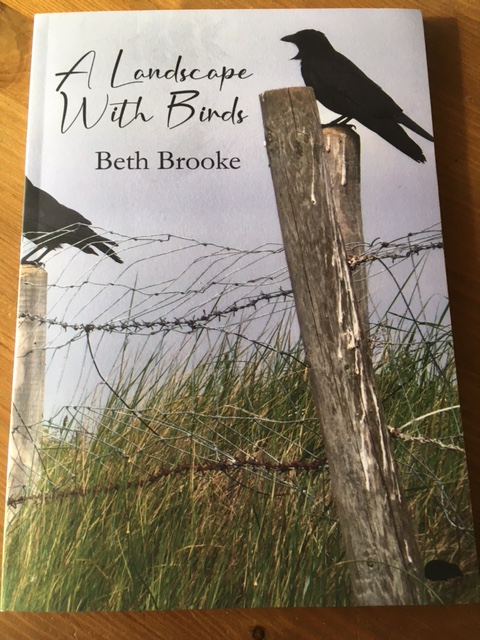
A Landscape with Birds by Beth Brooke

This wonderful collection of short verse from author Beth Brooke is poignant, clever, and expressive. Beth brings the landscape to us, presses us to acknowledge we are linked to it, part of it, draws out of us our unacknowledged place in the world today. Simple lines can hit the mark and make us think of places we would rather be. In Ploughing, April 2020, we are on the sidelines watching a farmer plough a field, seagulls diving toward the turned earth. Yet in an instant we leave the rich winter field, those seagulls transporting us from the bucolic to the ocean in six simple words. We are there, we can feel the salt on our skin and the tang in the air because we know what it’s like to miss the sea, somehow we understand that intangible desire the sea arouses in us to be near it. And it is the much maligned seagull that takes us there.

Beautiful imagery, like a classic film or an assortment of incredible art, plays throughout this collection, pushing to the forefront birds and their landscape, from the opening poem Jackdaws (and you know it’s true!) to the feathery, flitting, daring nonchalance of sparrows and the oh so sad kauai o’o bird. Every poem demands a second read – sometimes a third – and returning to the book a month or so later, you’ll find yourself wanting to read them all again at once.

We Take Our Son to University is a lovely lovely poem, so neat, so gentle, touching. And you can see that red kite, skimming across the page as you read the words. In Betrayal, the flight of ravens articulates the words that cannot be said; they speak for anyone wounded by duplicity.

            If you like birds, nature, the landscape all tied together in beautiful poetry, then I would recommend a read of this book. It’s not a big book, coming in at only 31 pages, but each poem is patiently observed and crafted. An absolute gem.

A Landscape with Birds is published by Hedgehog Poetry Press, Bristol.

http://www.hedgehogpress.co.uk

Review and Author Interview

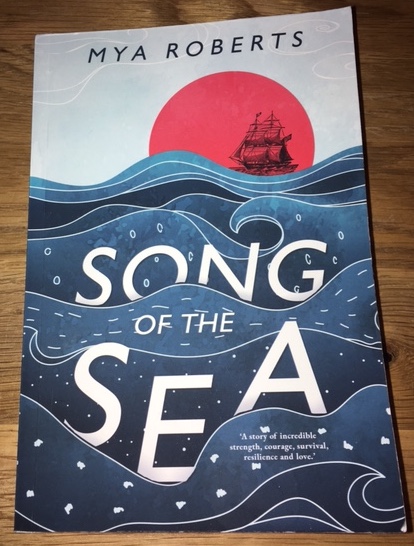
Mya Roberts, Song of the Sea

Mya is a Guernsey author and the sea has always been an essential part of her life. Last year she completed her first novel, Song of the Sea, and will be appearing at this year’s Guernsey Literary Festival. I met Mya many years ago on a writing course and it was there she read the first few captivating chapters of what was to become Song. The first question then Mya, and of course the most obvious, what is your book about?

My story starts on Guernsey in the Channel Islands in the 1700s. My main character, Elise, has a pioneering spirit and is about to leave the only home she’s known in order to join her fisherman husband, Thomas, in Nova Scotia. We follow Elise across the Atlantic Ocean and into the arms of her husband and her life as a fisherman’s wife. Her adventures exceed her expectations, the splendours and extremes of her environment are beyond her imaginings; her trials and fears challenge her courage to the full.

That sounds a very interesting story – where did the idea come from?

Some years ago, my husband Ian and I were exploring Nova Scotia, Canada, in a 32ft recreational vehicle we named ‘The Beast”. On The Beast’s aerial we proudly displayed a little Guernsey flag. The area is spectacular, the campgrounds were a delight and the people were warm and generous. We were having the time of our lives. In our travels we discovered Isle Madame and on Isle Madame we came upon a harbour named Arichat. We saw two cannon pointing out towards a small, unimposing island. A plaque read, “Jersey traders, who were French-speaking British citizens, settled on Jerseyman Island off Arichat in the late 18th century. The island was later attacked by American privateer John Paul Jones, forcing the inhabitants to move to Isle Madame.”  I’m a writer. Need I say more?

Indeed not! What great inspiration. And of course coming from an area where the sea is part of everyday life, did you find it easy to start writing Song?

We do possess some of the most beautiful coastline you can imagine, though on a much smaller and in general less rugged scale than in that part of Canada. I was born by the sea, and have lived with the sea most of my life. To my mind the sea does speak and the range of its voice is extraordinary. 

How quickly did your main character form?

Elise and Thomas grew slowly and surely as the story developed. Marcel was more of a wild card. Each of my three main characters surprised and challenged me as they evolved. It was rather like producing and at the same time acting in play. You start with a story outline, which develops and you enrich your characters, and they enrich your story and your story enriches them.

How much research did you do?

It was endless and I loved it. Like a treasure hunter I sifted and pried. I went to Jersey to investigate the archives, and I interviewed experts, and, best of all, returned to Nova Scotia (and the 32ft Beast) to follow Elise’s journey, make notes, take photos, and undertake more interviews. It was difficult to leave great quantities of that fascinating material on the ‘cutting room floor’. I had to accept that my reader may not be as enthralled with the drying and salting process of fish as I had become.

Well Mya, you might be surprised there! Many authors of historical fiction read works by other historical fiction writers – who knows what one author can learn from another.  Once you’d done all your research and gathered all your lovely facts, how did the editing go? Do you see it as a necessary evil or something you enjoy?

A bit of each. The torment of a scene or a chapter that doesn’t work is deeply frustrating. The sculpting of a book when it blossoms on the page is a joyful thing.

Did you let the book stew – say, leave it for a month and then come back to it to edit?

It stewed to the point of extinction many times.

Well I’m glad you persevered! Now, tell us about that gorgeous cover.

The cover started life rather Beige. A beige sea. I suspect my publishers were testing the ground by offering me a starting point. I was afraid they’d transform Elise into a double D, bodice ripping, lip-pouting glamour girl. Instead they offered that vivid startling sea, the glorious sunset and the galleon. It was love at first sight.

And so from cover to publishing – how are you publishing this book and why?

I have enough rejection slips to paper at least one wall. But I realise now that Song was rejected for good reasons. I dried my tears, stopped sulking, then started over. Only better.  Cranthorpe Millner accepted Song just weeks before Christmas 2021, and only weeks after I’d just completed major surgery followed by a gruelling course of Chemo. The offer was a good sign for the future, perhaps?  After all, I had to be around for book signings, didn’t I?

You most certainly do. Do you have a strategy for finding reviewers?

I gave my publishers a list of possibilities and they took it from there. A handful are in Canada, and they are very enthusiastic and supportive. I think I’m going to be big in Canada.

If you could have been the original author of any book, what would it be?

Something amazingly clever. Something that looks like it flowed from the  author’s brain to their keyboard in one smooth, electric stream: All The Light We Cannot See, Where the Crawdads Sing, JK writing as Robert Galbraith, or a Hillary Mantel, perhaps.

And finally…

What advice would you give to your younger self?

You’re worth more than you think, more talented than you feel and cleverer than you believe: now go for it.

Song of the Sea is the account of Elise’s journey – real and metaphorical – from her sheltered upbringing in Guernsey to Nova Scotia, Canada in 1755. Once reunited with her fisherman husband Thomas, she faces the unforgiving realities of life as a fisherman’s wife. Before she departs her home of Guernsey however, we see glimpses of the life she is leaving behind, of her gift as a herbalist that could end up seeing her hanged for witchcraft, a gift her grandmother made her promise to keep secret. As Elise’s new life unfolds in Nova Scotia there are distant rumblings of war, the threat of how her and her husband Thomas’s life could change forever. There is love, and loss, but also achievement and triumph as we travel with Elise to a time and place about which very little was known. She experiences motherhood, brutal war, and endures the horror of attack on her husband, and hopes in time to nurse him back to some sort of health. Throughout, Elise has to call upon strength she did not know she had. As her fortunes twist and turn Elise becomes a respected herbalist, a teacher and more. She becomes an independent woman in an age of great turmoil when women had very little choice over the lives they led.

We see her grow, and age, embracing one last challenge before her time is done, at one with the song of sea.