Don’t you just love January? Oh c’mon, it’s a great month! So much to look forward to. Do you notice the days getting a teensy bit longer? So it may be cold/wet/snowy/bright/sunny/windy/all of the above but it means the earth is tilting toward the sun again, at least here in the northern hemisphere. Daylight will be returning and before you know it the crocus and daffs will be out, such horticultural joy sending us all a tiny bit doolallie for a while.
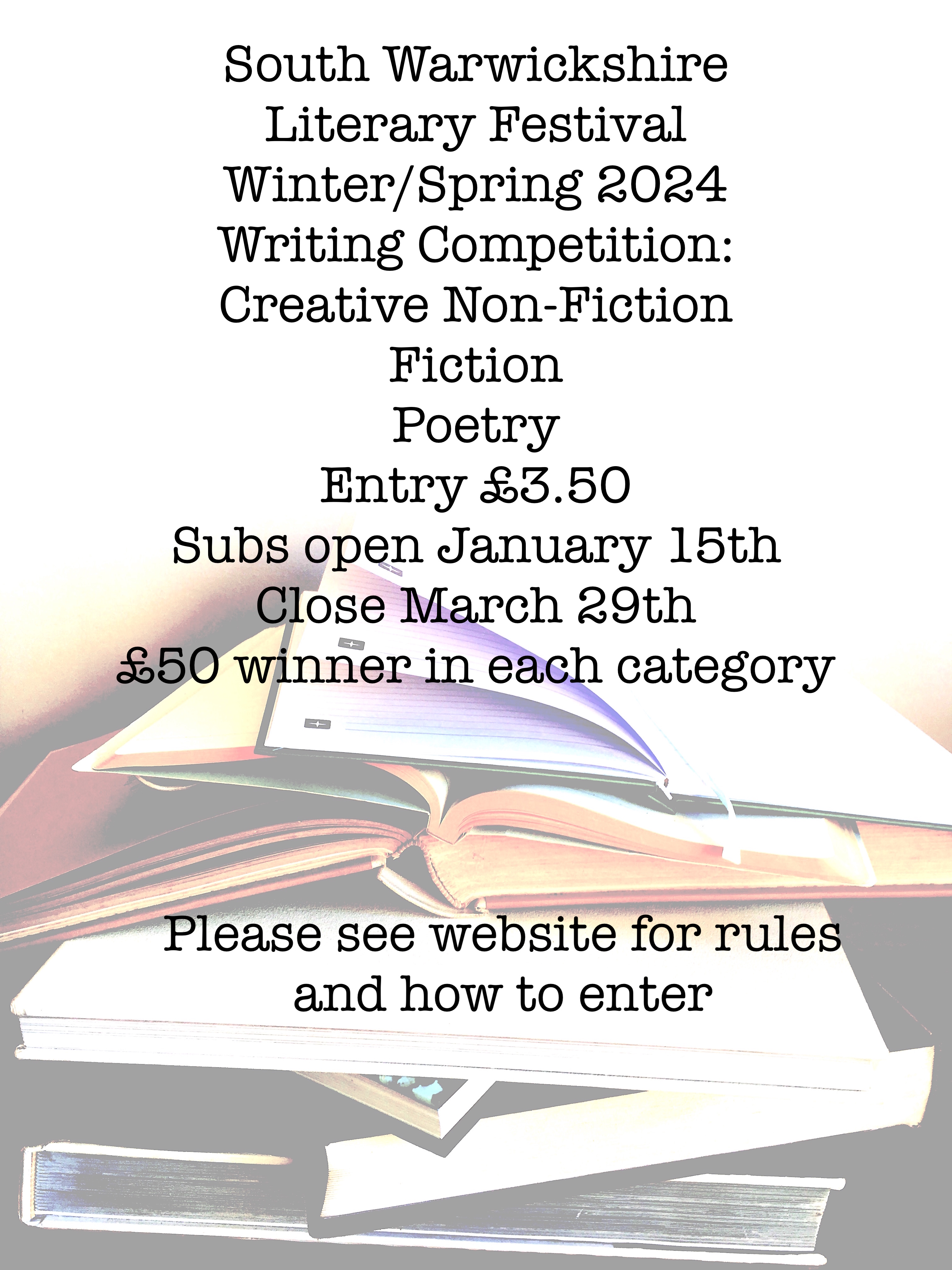
And what better news than knowing the South Warwickshire Lit Fest’s writing competition opens for submissions on January 15th. That’s next week! The categories are the same as last year – Fiction, Creative Non-Fiction and Poetry and the entry fee is a paltry £3.80 (actually £3.50 but there is a 30p booking fee) with a £50 prize in each category. Closing date is March 29th so there is Per-Len-Tee of time to create your masterpiece whether some cracking poetry, stunning creative non-fiction or gasp-out-loud fiction. We’ll be shouting about it all over the socials, FB, X, I, BS – is that an anagram I wonder? – and we’re very much looking forward to your entries. All the details on how to enter are on our website – basically pay your entry fee then email us your work plus your Ticketsource reference number, here South Warwickshire Literary Festival.
When I created SWLF it was not in the mix to have writing competitions but since we introduced them they have been a marvellous insight in to what people are currently writing. Supporting the Warwickshire Young Poet Laureate, who for 23/24 is May Vaughan, is always a delight, and interesting to see what younger people are writing about – so important that these voices get heard.
So here’s to your entries dear reader. I’m not a judge, just curator, so although I get to read all your lovely words my opinion counts for jack – we’re leaving the judging to the experts -all of whom will be revealed in the fullness of time..
So what are you waiting for ? Stop reading this and get writing!!
And if you know a young person in Warwickshire, aged 13-17 who could be the next YPL…
Entries for Warwickshire’s Young Poet Laureate 2024/25 will open in June 2024 at warwickshire.gov.uk/youngpoetlaureate. For more information about the Young Poet Laureate scheme please email libraryevents@warwickshire.gov.uk or your local library service if reading this in the UK.
At the end of last month I was at the Oxford Indie Book Fair as part of Banbury Writers’ Cafe, strutting our stuff and mixing and mingling. It was a fun day out and someone even bought my book which caused both merriment and delight. It’s been ages since A Collection of Unsettling Short Stories saw the light of day and the sale did give me slight surge of energy to get on with the sequel. However, as founder and Festival Director of the South Warwickshire Literary Festival there don’t seem to be enough minutes in a day to actually get round to it. So I thought I’d do a little blog instead. Well, y’know… displacement activity and all that…
My first collection of short stories I self-published yonks ago amidst teenagers’ driving lessons, daily taxi trips to college, walking my neighbour’s dog, writing a novel, working part-time, attending writing courses and a myriad of other activities now all lost in time. Six years later you’d think I’d have got round to A Collection of Unsettling Short Stories pt 2 wouldn’t you. Hmm. I have to agree. But no. The work’s all there, waiting for the Big E. Yep that’s right. The Big Edit. So, obviously daunted by the fact that this was a job I really needed to do I got on and did other things instead. Live Lit Evenings. Self-Publisher’s Showcase at the Stratford Literary Festival. Reviewing. Runner-up in writing competitions. My goodness what an impressive list of excuses!
Having chastised myself over a glass of red wine and an early advent calendar – what? don’t tell me you haven’t been tempted – I decided to send myself away…from myself…and am going to a writing weekend festival at Gladstone’s Library in February. This has given me tremendous focus to spend the weekend working on my current novel with the intention of actually finishing it. As in, ending it. As in, making it complete and done with. And I’m really looking forward to it. I have my story arc, my gang of characters, I have happy and sad, I have inciting incidents and unexpected What Ifs. I have it all ready to go and this time, I’m gonna do it. I must have known when I bought the 2024 Writers’ and Artists’ Yearbook that I was up to something.
So as Christmas approaches I shall go with the flow of the season, meanwhile feeling the excitement of my novel writing weekend growing, like a little bird getting bigger and bigger until it’s ready to fly.
And how about you, dear reader? Where are your writing endeavours taking you in the coming months? Leave a comment if you will, I’d love to know.
Or at least stand a chance. Having been the curator and administrator of several writing competitions over the last few years I understand what comp organisers mean when they ask for ‘new voices’ or ‘new ideas’ or ‘fresh perspectives’. What they are politely saying is please don’t send us any more stories on death, divorce, dementia, aged parents, losing children, losing your mind, nostalgia, what you did at school, how the old days were better and absolutely nothing that involves the wearing of rose tinted glasses. Sometimes the old adage write what you know is not necessarily a good thing. The list above is of course a list of life events but does everyone need to read about yours? Or if they do, can you write it in a different way? Can you step out of your comfort zone and write something set in the future for example? Or, if you are sci-fi writer, write an historical piece?
If you enter a lot of competitions but seem to get nowhere, there has to be a reason, right? Do you read previous winners and runner-ups? Can you see the difference in what the winner has written and your entry? Do you have a favourite piece of your own work that you enter in many comps but get nowhere with? Dare I say there has to be a reason for that. I know, brutal, and after all, one judge’s opinion is just that, their opinion – because they didn’t choose you doesn’t necessarily mean they didn’t like your work, they just liked someone else’s more. But there is a good chance that it failed at the first hurdle because the subject chosen was commonplace and there could be fifteen other entries written on the same subject. Do not be so in love with your story that you can’t see its flaws.
A long time ago I read a winning short story about a wake. Oh here we go, I thought. Same old same old. But no. The setting was Belfast in the 1970s and a bomb exploded just outside where the wake was taking place. Consequently nearly all the action of the story took place from a child’s perspective as they hid from the chaos underneath the bier. The story stuck with me because I pre-judged it as being the usual death/funeral story with the usual mourners with no doubt a stereotypical end. And it wasn’t any of those. If the writer is still out there and reading this – your work worked! I can still recall it now, many years later.
I’ve entered a few competitions in the last few months and not reached any longlists, let alone short lists. But it always serves as a good shake to my writing. Simply, write better! I know what I must do.
Tips!
1. Always read previous winners. How many include the life events mentioned earlier? If none, and yours does, maybe think twice before sending it in.
2. Buy anthologies – good ones. Professional writers’ groups and small publishers will print their winning collections and they are a good place to start.
3. Spare a thought for the organisers, readers and judges receiving your work. They are not therapists! Yes, your work can be emotive, but don’t slip into self-indulgence or melancholy.
4. Choose a subject different from your usual choice. Used to be a teacher so feel compelled to write a school-based story? Or a dentist, just itching to write about customers and their teeth? Stand back, take a deep breath, and walk the other way.
5. Ask for beta readers. Ask me, if you like!
6. Here’s a prompt for you: You are in Peru. You see a small artefact on the ground and pick it up. What happens next? 800-1000 words; no life events!
‘..so I told him straight, I wasn’t putting it anywhere near him…’
Fret not dear reader, I resisted the urge the hurl my trolley round the corner and follow the orator stealthily through the salad aisle in the hope of discovering what it was she wasn’t going to put anywhere near him, but I can tell you, the urge was incredibly strong. Instead, I distracted myself with the lack of cucumbers and pondered instead on what she could possibly have been talking about and how I could fit it into a short story. Was she reassuring him that she wasn’t putting the crocodile/the broken bottle/it anywhere near him, or was she refusing to put the crocodile/broken bottle/it anywhere near him? Alas it will always be a mystery to me as she disappeared down the cheese aisle still chatting on her phone and by the time I caught up with her in the bread aisle the call was complete. I had no way of knowing. Her poker face offered nothing. Brown or white bread seemed to be her only concern. We parted ways in the rice and bean aisle and by the time I got to the wine aisle a story had formed. The next hurdle was remembering it without writing it down. Well you can imagine what the outcome of that was.
Needless to say I returned to my office later that day and set about dismembering my 500 word short story which has been slowly growing and transmogrifying into a completely different story to the one I originally started writing. Gone were two of the main characters and in their place was a soldier and a man who might turn into a milkman at any given moment. I think I may have lost the plot temporarily. I was keen, you see, to implant, somewhere, my newly over-heard dialogue. The fact that it didn’t fit in to any of the story didn’t faze me. It should have done of course as I wasted another two and half hours trying to insert a sentence into a story that had about as much right to be there as a spider in a fridge.
You can imagine how it all ended. The short story was re-written for the 110th time and the sentence only made it as far as this blog. Well, as a fan of recycling and reusing, I can’t see any problem with that. But even so, I wish I knew what she’d been talking about…
As TS Eliot correctly acknowledged, the naming of cats is a serious matter. As is your main character, or indeed a home, the place where all the action happens. Manderley for example. Serious action going on there. The House at Pooh Corner – not quite the same but still notable literary history, plus the added bonus of imparting a geographical location sans gps – just as long as you know where Pooh Corner actually is I guess.
Don’t bite the apple Snow White…
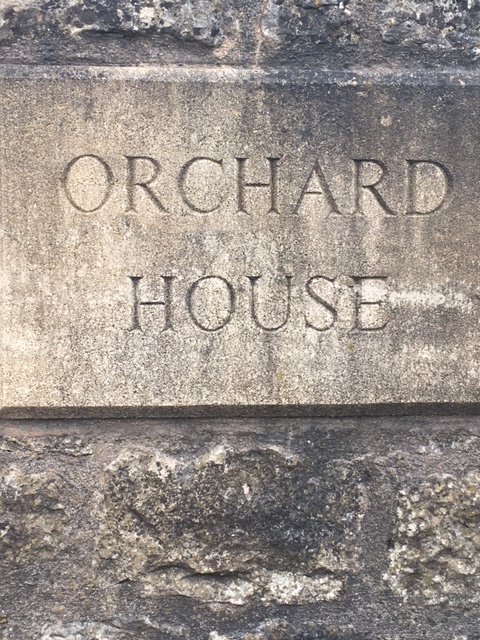
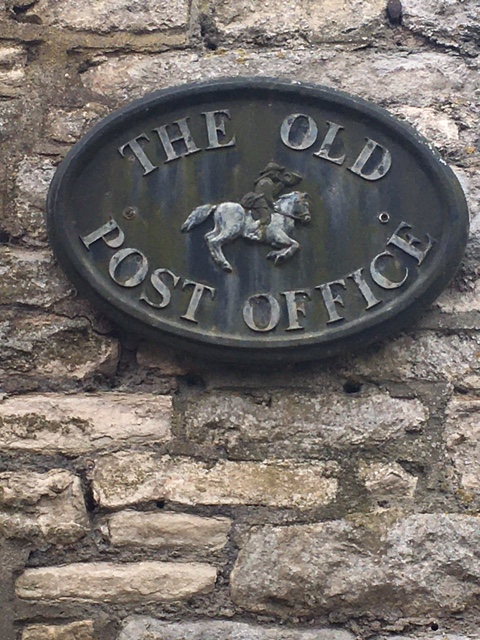
On my Covid roamings my ever-observant eyes have paid more attention to local house names – apple anybody? – and the history-loving part of me mourns the death of Orchard Cottage (not an apple in sight), The Oaks (treeless), The Old Post Office, The Old School, Rose/Jasmine/Lavender/Yew Cottage. Scattered across the country are countless Blacksmith’s Cottages, Station Houses, and Old Mills, all a wonderful nod to the past and how lives were lived. But that was then and this of course is now. Where are the new names? Couldn’t we do with an I.T. Terrace perhaps, or a Broadband Bungalow? Or maybe Seeseeteevee Lodge, or simply just Renewables for a new housing estate on a windy site? As if someone had been thinking along the same lines as me, I did see one modern terraced house recently with a quaint 21stcentury millennial ring to it: it was named Tiny Box. True. The new owner was clearly being sardonic/humourous/notworriedaboutsellingit and it made me smile. Surely, as we stride ever forward, our achievements, as the industrious creative humans we are should be recognised in the naming of our homes? Holme Delivery? Still At Home With Mum & Dad House? (bit long for any on-line form, that one) or (and I promise this is the last one) Can’t Really Afford It Cottage. Where house names once reflected our jobs or the natural world perhaps in the future they’ll reflect the socio-politics of the time. Perhaps they should. Anyway, just a thought. A thought that brings me on to the importance of other names; our characters. Yes, like many a writer my path always returns to the plot, the people, and that pesky protagonist.
A question for you dear reader. What do Harry Potter (pick an installment) Hamlet, Rebecca, Matilda (know where this is going?) have in common? Exactly. Each novel is the title of the main character. Yes yes I know that in the case of Rebecca ***SPOILER ALERT!!*** she’s not exactly there, being dead an’ all, but you know what I mean. It ensures that we’re not likely to forget them in a hurry doesn’t it? Leap forward some decades and ask yourself if you can remember the name of the protagonist in a book you read three months ago. Or the book before last. But seriously – what better way to get your work into the psyche of your readers? Nail the name and the rest should come, surely?
Hunton Gurney. Top lawyer. Privately educated. 21stCentury Guy. London apartment, cottage in Cornwall (Fisherman’s, probs), expensive car, almost married to another high-flier. Or Hunton Gurney, 18thcentury labourer – no – let’s make him a blacksmith (and we all know where he lives), back already damaged from hard work, four living children, two others already dead from consumption, married to the exhausted but determined Rose. Or…Hunton Gurney, a small, mysterious village off the A436 somewhere between the Oxfordshire and Gloucestershire border.



 Jacci Gooding, Author
You must be logged in to post a comment.