
Calling All Authors – Your Library Needs You!

A few weeks ago as part of the Warwickshire branch of the Society of Authors, I was lucky enough to attend a meeting with our local library service. It was eye-opening. We learned how the books you see on the library shelves are chosen, how a self-published author would get to share this hallowed space, and how important it is for authors however published to be engaged with their local library. For example, author Erin Green gave an hour-long talk to a well-supported audience at Warwick library earlier in the month and it was only when listening to her and chatting with her afterward I realised how lucky we are as authors to have these spaces available to us – for free – with an almost guaranteed audience. Our readers don’t always have to buy our books; authors get fees each time their book is borrowed from a library so what better place to promote your work? The lovely librarians we spoke with explained the PLR (Public Lending Right) system which is administered from The British Library, which states on their website ‘If you are a published author, illustrator, editor, translator or audiobook narrator you could receive remuneration as a result of public library book loans.’ So using your library as an author and as a user is such a win-win. Are you an author reading this? Do you work with your library to promote yourself and them? Didn’t know you could? Drop them and email swiftish then, and find out if you’re just what they’re looking for! For us here in Warwickshire the library service will also display a poster for an author event if it is local, is an activity relating to local societies and/or organisations, and promotes writing. And only one of those boxes needs to be ticked.

            According the WCC libraries website they have almost 605,000 items on their shelves – that includes audio books, play scripts and music scores – and lend approximately 1.7 million items a year. One.Point.Seven.Million. Just in case you missed it. That’s an astonishing amount of written and spoken words. Some of them could be yours (or mine!)

            We were also introduced to an organisation called The West Midlands Readers’ Network which ‘supports reading by creating opportunities for readers and reading groups to engage creatively with literature, and to deepen their reading experiences.’ They ‘run a range of events, activities and projects with libraries and independent bookshops including commissions, creative reading events, a ‘Reader in Residence’ programme, plus networking and skills-sharing across the West Midlands.’ Do you have something like that in your area? Not sure? Ask a librarian!

            Myself and other SoA members had a really creative and collaborative couple of hours with the super librarians at Kenilworth Library. Another SoA member joined us from Birmingham where she told us the sad and damn-well outrageous news that Birmingham City Council, being bankrupt, has been forced to close all its libraries. Can you imagine living in a city without a library? I can’t. I can’t contemplate the hole that will leave in the lives of so many and the damage it will do to our young readers who are going to be denied the opportunity to access free books. It is an established fact that those who are encouraged and assisted to read from an early age are often well ahead of their peers in later life. Can you even contemplate not being able to read?

            So, top tips for you if you’re an author

  • Contact your local library to see what events are being run
  • Go to some of them! Meet people, support the library, network
  • Apply/ask to lead an authors hour (if that is what they do – other formats are available!)
  • Search out organisations in your area that collaborate with authors
  • Be that author

Love Letter to Myself (ok, poem then)

A little ditty to myself to encourage that WIP to take flight. (But note, I've never won a prize for poetry...)

Will you be my Valentine?
I'd like it very much
I simply love the things you write
You've such a clever touch.

Your prose is just incredible
Your characters so true
Your confidence across the page
So quickly comes in view

With synonyms and grammar good
Your plot is thick and strong
No chance of getting quite unstuck
Or the storyline undone

Oh you’re such a clever writer
No more should be said
Just get the damned thing written though
And don’t procrastinate instead!

Back. Patted.

Writing Competition Time

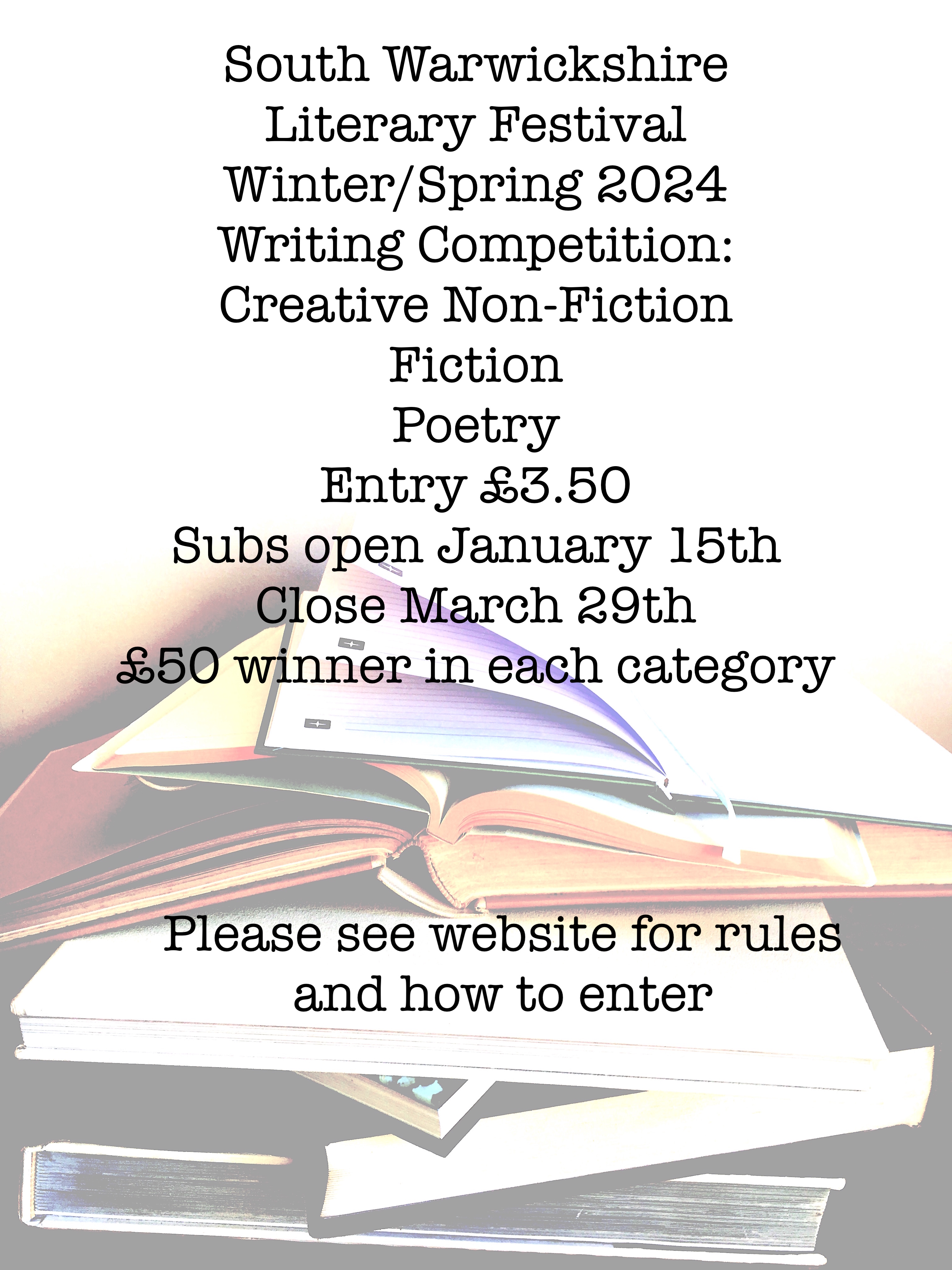
Don’t you just love January? Oh c’mon, it’s a great month! So much to look forward to. Do you notice the days getting a teensy bit longer? So it may be cold/wet/snowy/bright/sunny/windy/all of the above but it means the earth is tilting toward the sun again, at least here in the northern hemisphere. Daylight will be returning and before you know it the crocus and daffs will be out, such horticultural joy sending us all a tiny bit doolallie for a while.

And what better news than knowing the South Warwickshire Lit Fest’s writing competition opens for submissions on January 15th.  That’s next week! The categories are the same as last year – Fiction, Creative Non-Fiction and Poetry and the entry fee is a paltry £3.80 (actually £3.50 but there is a 30p booking fee) with a £50 prize in each category. Closing date is March 29th so there is Per-Len-Tee of time to create your masterpiece whether some cracking poetry, stunning creative non-fiction or gasp-out-loud fiction. We’ll be shouting about it all over the socials, FB, X, I, BS – is that an anagram I wonder? – and we’re very much looking forward to your entries. All the details on how to enter are on our website – basically pay your entry fee then email us your work plus your Ticketsource reference number, here South Warwickshire Literary Festival.

When I created SWLF it was not in the mix to have writing competitions but since we introduced them they have been a marvellous insight in to what people are currently writing.  Supporting the Warwickshire Young Poet Laureate, who for 23/24 is May Vaughan, is always a delight, and interesting to see what younger people are writing about – so important that these voices get heard.

So here’s to your entries dear reader. I’m not a judge, just curator, so although I get to read all your lovely words my opinion counts for jack – we’re leaving the judging to the experts -all of whom will be revealed in the fullness of time..

So what are you waiting for ? Stop reading this and get writing!!

And if you know a young person in Warwickshire, aged 13-17 who could be the next YPL…

Entries for Warwickshire’s Young Poet Laureate 2024/25 will open in June 2024 at warwickshire.gov.uk/youngpoetlaureate. For more information about the Young Poet Laureate scheme please email libraryevents@warwickshire.gov.uk or your local library service if reading this in the UK.

Finding Time to Write that Novel

At the end of last month I was at the Oxford Indie Book Fair as part of Banbury Writers’ Cafe, strutting our stuff and mixing and mingling. It was a fun day out and someone even bought my book which caused both merriment and delight.  It’s been ages since A Collection of Unsettling Short Stories saw the light of day and the sale did give me slight surge of energy to get on with the sequel. However, as founder and Festival Director of the South Warwickshire Literary Festival there don’t seem to be enough minutes in a day to actually get round to it. So I thought I’d do a little blog instead. Well, y’know… displacement activity and all that…

My first collection of short stories I self-published yonks ago amidst teenagers’ driving lessons, daily taxi trips to college, walking my neighbour’s dog, writing a novel, working part-time, attending writing courses and a myriad of other activities now all lost in time. Six years later you’d think I’d have got round to A Collection of Unsettling Short Stories pt 2 wouldn’t you. Hmm. I have to agree. But no. The work’s all there, waiting for the Big E. Yep that’s right. The Big Edit. So, obviously daunted by the fact that this was a job I really needed to do I got on and did other things instead. Live Lit Evenings. Self-Publisher’s Showcase at the Stratford Literary Festival. Reviewing. Runner-up in writing competitions. My goodness what an impressive list of excuses!

Having chastised myself over a glass of red wine and an early advent calendar – what? don’t tell me you haven’t been tempted – I decided to send myself away…from myself…and am going to a writing weekend festival at Gladstone’s Library in February. This has given me tremendous focus to spend the weekend working on my current novel with the intention of actually finishing it. As in, ending it. As in, making it complete and done with. And I’m really looking forward to it. I have my story arc, my gang of characters, I have happy and sad, I have inciting incidents and unexpected What Ifs. I have it all ready to go and this time, I’m gonna do it. I must have known when I bought the 2024 Writers’ and Artists’ Yearbook that I was up to something.

So as Christmas approaches I shall go with the flow of the season, meanwhile feeling the excitement of my novel writing weekend growing, like a little bird getting bigger and bigger until it’s ready to fly.

And how about you, dear reader? Where are your writing endeavours taking you in the coming months? Leave a comment if you will, I’d love to know.

Six Tips For Scary Writing

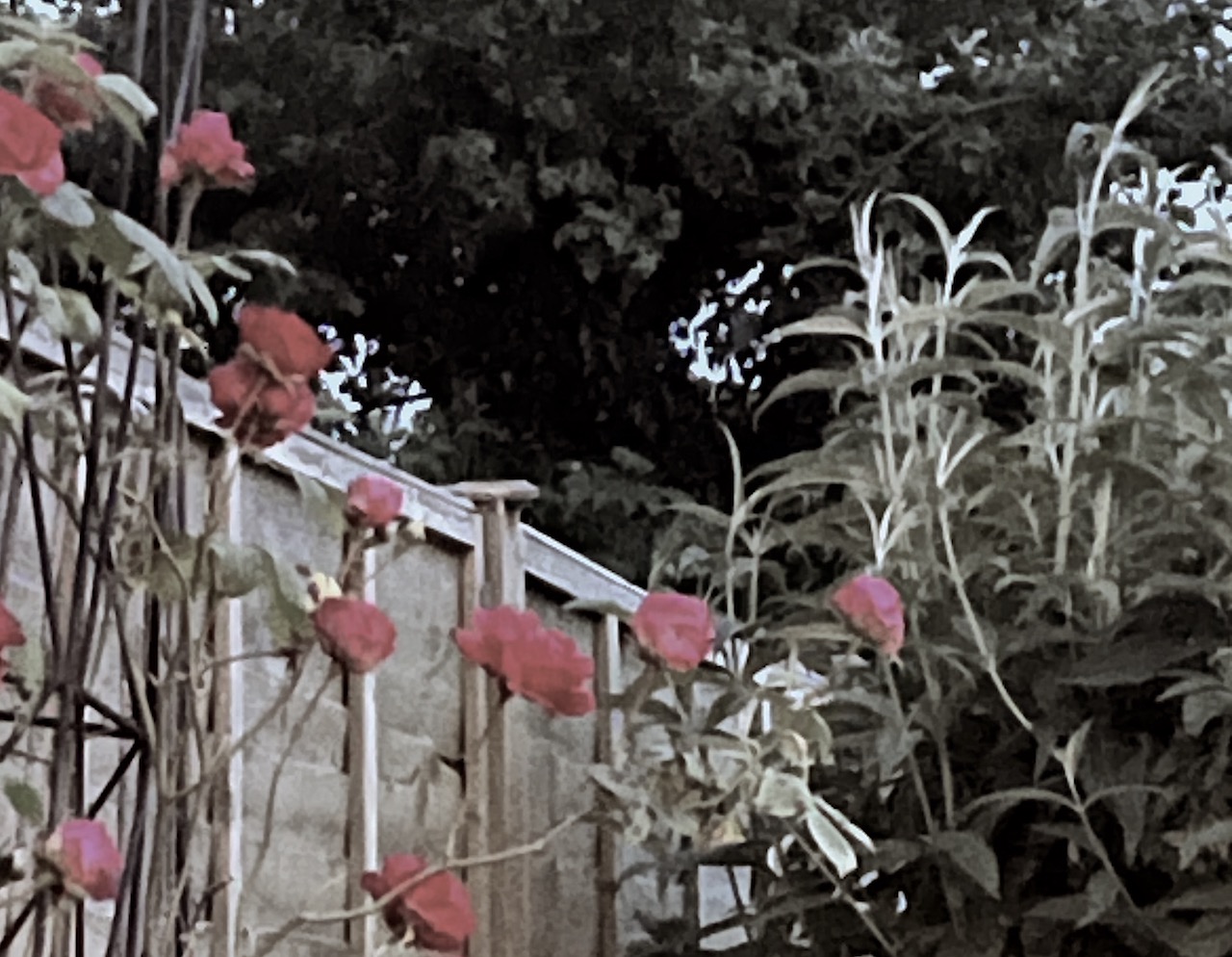
Take a look. What do you see? Nothing much? Or a giant googly-eyed monster looming out of the darkness over this fence?

Horror writing. The best is all in the detail. Or lack of it. Let the reader use their imagination, let them see things through your words. Sounds easy, right? Well we all know it’s not. How to create tension, how to get the reader hiding – metaphorically – under the bed. How how how. As a horror/ghost story lover since childhood I’ve tried so many times to write a really good ghost story. Wrote, edited, believed. Set it aside. Went back several months later and howled like the proverbial wolf man with laughter at just how awful it was. The trick, as I understand it, is to leave the reader with a feeling that either a thin trickle of cold water is dripping down their back or a merest touch from a ghostly hand has just brushed their neck. Right. I’ll get on it then. Sounds so eeeeeeasy.

What do we need?

  1. A creepy setting. Could be a grave yard but that is sooo yesterday. Unless it’s a modern grave yard. What is a modern grave yard? (cue internet search for 21st century funerals)
  2. Odd characters. The sort that appear unexpectedly and look just a bit…y’know… deranged in an unthreatening kind of way – until it’s too late
  3. A mystery. Take your pick. A mystery sound. A mystery sighting. A mystery smell. A mystery person. A mystery mystery…. you get the idea.
  4. An unexpected and clever twist. Unexpected and Clever? Jeez. Not making this easy.
  5. A monster. Or unexplained creature. Like a googly-eyed monster leering over a fence. Just sayin.
  6. And, I suppose, knowing what it is people are scared of these days. There’s enough ghost hunter footage out there that tells us we are still afraid of the paranormal, because now, we could say – and I’m just putting it out there – it could actually be real. Which is scarier: the ghost idea or the concept that it is real?

How To Win A Writing Competition

Or at least stand a chance. Having been the curator and administrator of several writing competitions over the last few years I understand what comp organisers mean when they ask for ‘new voices’ or ‘new ideas’ or ‘fresh perspectives’. What they are politely saying is please don’t send us any more stories on death, divorce, dementia, aged parents, losing children, losing your mind, nostalgia, what you did at school, how the old days were better and absolutely nothing that involves the wearing of rose tinted glasses. Sometimes the old adage write what you know is not necessarily a good thing. The list above is of course a list of life events but does everyone need to read about yours? Or if they do, can you write it in a different way? Can you step out of your comfort zone and write something set in the future for example? Or, if you are sci-fi writer, write an historical piece?

If you enter a lot of competitions but seem to get nowhere, there has to be a reason, right? Do you read previous winners and runner-ups? Can you see the difference in what the winner has written and your entry? Do you have a favourite piece of your own work that you enter in many comps but get nowhere with? Dare I say there has to be a reason for that. I know, brutal, and after all, one judge’s opinion is just that, their opinion – because they didn’t choose you doesn’t necessarily mean they didn’t like your work, they just liked someone else’s more. But there is a good chance that it failed at the first hurdle because the subject chosen was commonplace and there could be fifteen other entries written on the same subject. Do not be so in love with your story that you can’t see its flaws.

A long time ago I read a winning short story about a wake. Oh here we go, I thought. Same old same old. But no. The setting was Belfast in the 1970s and a bomb exploded just outside where the wake was taking place. Consequently nearly all the action of the story took place from a child’s perspective as they hid from the chaos underneath the bier. The story stuck with me because I pre-judged it as being the usual death/funeral story with the usual mourners with no doubt a stereotypical end. And it wasn’t any of those. If the writer is still out there and reading this – your work worked! I can still recall it now, many years later.

I’ve entered a few competitions in the last few months and not reached any longlists, let alone short lists. But it always serves as a good shake to my writing. Simply, write better! I know what I must do.

Tips!

1. Always read previous winners. How many include the life events mentioned earlier? If none, and yours does, maybe think twice before sending it in.

2. Buy anthologies – good ones. Professional writers’ groups and small publishers will print their winning collections and they are a good place to start.

3. Spare a thought for the organisers, readers and judges receiving your work. They are not therapists! Yes, your work can be emotive, but don’t slip into self-indulgence or melancholy.

4. Choose a subject different from your usual choice. Used to be a teacher so feel compelled to write a school-based story? Or a dentist, just itching to write about customers and their teeth? Stand back, take a deep breath, and walk the other way.

5. Ask for beta readers. Ask me, if you like!

6. Here’s a prompt for you: You are in Peru. You see a small artefact on the ground and pick it up. What happens next? 800-1000 words; no life events!

7. Check out unconscious bias – you might surprise yourself.