Finding Time to Write that Novel

At the end of last month I was at the Oxford Indie Book Fair as part of Banbury Writers’ Cafe, strutting our stuff and mixing and mingling. It was a fun day out and someone even bought my book which caused both merriment and delight.  It’s been ages since A Collection of Unsettling Short Stories saw the light of day and the sale did give me slight surge of energy to get on with the sequel. However, as founder and Festival Director of the South Warwickshire Literary Festival there don’t seem to be enough minutes in a day to actually get round to it. So I thought I’d do a little blog instead. Well, y’know… displacement activity and all that…

My first collection of short stories I self-published yonks ago amidst teenagers’ driving lessons, daily taxi trips to college, walking my neighbour’s dog, writing a novel, working part-time, attending writing courses and a myriad of other activities now all lost in time. Six years later you’d think I’d have got round to A Collection of Unsettling Short Stories pt 2 wouldn’t you. Hmm. I have to agree. But no. The work’s all there, waiting for the Big E. Yep that’s right. The Big Edit. So, obviously daunted by the fact that this was a job I really needed to do I got on and did other things instead. Live Lit Evenings. Self-Publisher’s Showcase at the Stratford Literary Festival. Reviewing. Runner-up in writing competitions. My goodness what an impressive list of excuses!

Having chastised myself over a glass of red wine and an early advent calendar – what? don’t tell me you haven’t been tempted – I decided to send myself away…from myself…and am going to a writing weekend festival at Gladstone’s Library in February. This has given me tremendous focus to spend the weekend working on my current novel with the intention of actually finishing it. As in, ending it. As in, making it complete and done with. And I’m really looking forward to it. I have my story arc, my gang of characters, I have happy and sad, I have inciting incidents and unexpected What Ifs. I have it all ready to go and this time, I’m gonna do it. I must have known when I bought the 2024 Writers’ and Artists’ Yearbook that I was up to something.

So as Christmas approaches I shall go with the flow of the season, meanwhile feeling the excitement of my novel writing weekend growing, like a little bird getting bigger and bigger until it’s ready to fly.

And how about you, dear reader? Where are your writing endeavours taking you in the coming months? Leave a comment if you will, I’d love to know.
7 Tips for Clever Writing

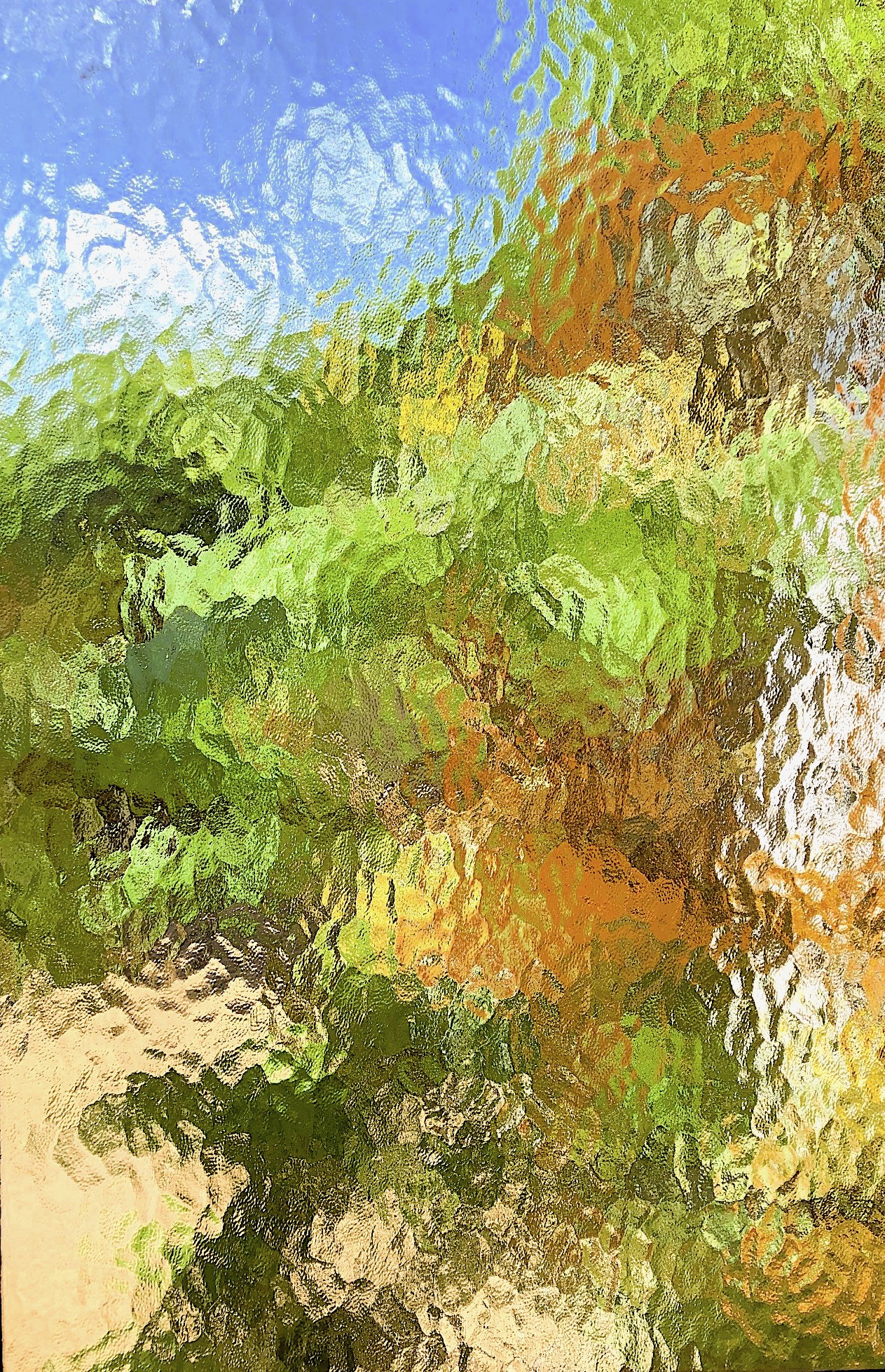
A few blogs back I wrote about being inspired by art. Well, with that in mind, I painted this picture to give vent to my lack of artistic talent. Like it? Not bad is it. I like the way the lines all merge together in a conclusion of colour that burst from the screen.

Confession time.

It’s a photo. It’s a photo of the sky and some plants taken through a wibbly wobbly window but it looks ok doesn’t it! Think you’re looking at one thing, but really you’re looking at another. That’s the trick. Now turn that into clever writing.

What do I mean by clever writing? What even is that?! Do I even know?

I guess I mean presenting the reader at the beginning with what they think is one thing but by the time they get to the end realise it’s a different thing altogether – but in a good way. Isn’t that what they call a Twist? Or Plot? Or maybe even a Plot Twist?

So here’re a few tips for you, should be you interested. Just my thoughts and observations… nothing too taxing. Let me know if you agree…or not

  1. Do your research then write like you haven’t. Eh? Wha..? As in, make your story so natural that your readers are drawn in straight away, without any time to argue the toss or disagree with what you’ve written. Make sure you know what you’re writing about in terms of exposition, especially in historic fiction.
  2. Writing science fiction? Make your new world as relatable as this old one and your readers will be there from the get-go. With time and good pacing of chapters you can unfold your new world without anyone really noticing and then bam – they’re residents of your new world without even booking a removal van.
  3. Without doubt clever dialogue is the way forward. What is clever dialogue? Is it what you hear all around, every day? Or is it well structured, over-long and completely unlikely? Do we speak now as Mr Darcy spoke then? Be brief. Be bright. Be Clever. If in doubt, chuck it out.
  4. Nab yourself a clever idea which will grow into your story giving rise to a great plot. Clever idea huh? Well excuse me while I just pop down to the clever plot shop. Simple’s always best. Make it too complicated – too many brush strokes – and you’ll lose your reader. Say for example you’re writing a cli-fi, how about the seas suddenly freezing over rather than warming up? Oh Contraire I hear you gasp.  It’s a 180 to the current crisis, so why not?
  5. Characters always help in a story, don’t you think? Making them mad a genius or an astronaut lost in space s a bit too clever – you’d have to know a lot about geniuses or space to pull that one off effectively. Nah, go clever. Writing crime? Police procedure? Let’s have no more of the grizzled-nearly-sacked-maverick-cop with a penchant for late night whiskey, but something cleverer. A deaf detective? Could be interesting.
  6. Develop a good support cast. Could be a horse. Could be a kid. Could be an older gent or lady with a secret past. Make your support characters shine.
  7. Read. Read other authors; work out why you like what they write. Read authors you’ve never heard of in genres you’d never normally consider. Give it a go, and be clever about it. Obvs.

Vincent van Gogh and Experimental Writing

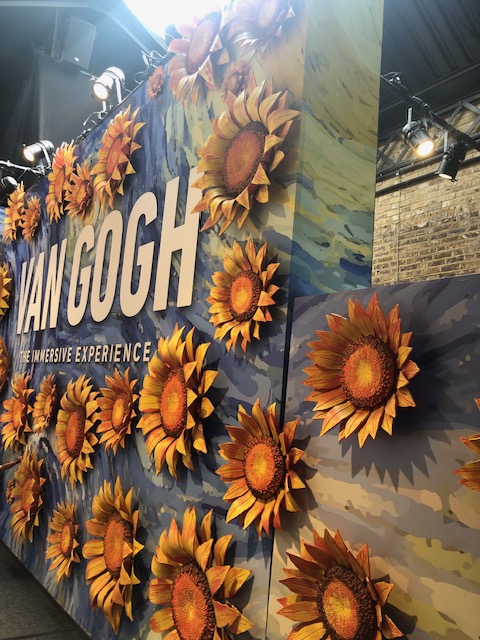
As you may have seen on a Twitter post from me recently I was lucky enough to visit the Vincent van Gogh Immersive Experience in Shoreditch and see for myself what all the excitement was about. And exciting it was.

I can’t honestly say I’m a fangirl of ol’ Vincent’s, but I do love a bit of art. Any art. The exhibition covered his life and premature death, his friendship with artist Paul Gauguin and the love of his brother. Did you know van Gogh originally wanted to be a priest? Me neither. You could say lucky for us that he failed in that respect.

The use of colour in Gogh’s work has often been discussed by those who discuss such things, and reading from the information sheets at the exhibition it seems that the conclusion drawn is that van Gogh may have suffered from xanthopsia, a condition which causes the sufferer to see in yellow more than any other colour. It’s not until you see so many of his hundreds of paintings together that you realise how much he loved his yellow. Think you know his sunflowers? Think again! He painted over 500 images of sunflowers, some of which you’ve probably never seen or even knew existed. It’s those big blousy ones in the vase that get all the attention. Drama queens.

Much of his work seemed to my untrained eyes very experimental – but then I’m no artist so what do I know – but according to the exhibition he had been told by one who knew so little, not to bother painting. He ignored such ill-founded advice and forged ahead.

Many of his preliminary sketches were on display and they put me in mind of a writer producing that scrappy first draft – you know the one – all puff and fluff, ideas and inspiration rather than proper prose and sentence structure.

How many times have you started with the puff and fluff, the idea and inspiration, to get fifteen minutes in declare it rubbish? That is not the way ahead my friend. Keep your puff and fluff, it could reap fantastic rewards a few months from now, because amongst the puff is the kernel of an idea that you had, and that must have some merit. Just because your whole story/novel/poem/essay isn’t formed yet doesn’t make it valueless.

Don’t be put off by that little niggly voice in your head telling you that what you’re writing isn’t any good. It might not be perfect – yet – but take a page off of Vincent’s canvas and stick with it.

The Old Allotments – a poem

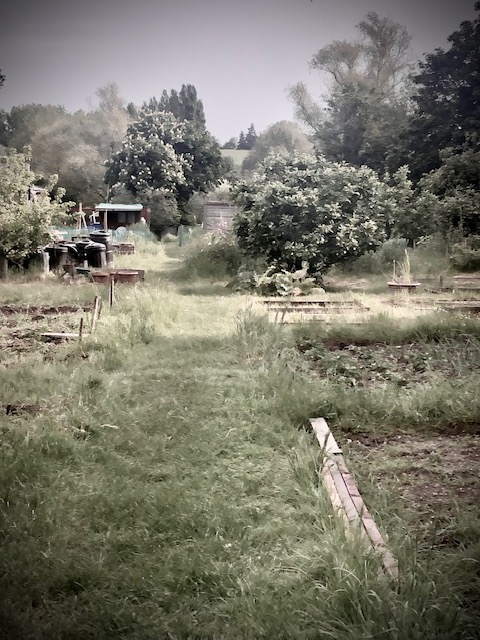
Following on from Sue Cook’s @popsytops blog about landscape which I reblogged last week, I too have been on a walk, recently passing the 120 year old St Mary’s Allotments in Leamington Spa. It’s hard to convey the gentle energy in spaces like this, but here goes..

Nourishment, earth fed, where

robins, blackbirds, crows reside,

grows plentiful and rich

beside the banks and riverside

Where working man has striven

long, his brow a sweat of toil

as hands, like spades with aching back

worked hard the heavy soil

To feed, to grow his many

crops, returning home triumphant

as empty mouths and stomachs waited

for succour and for comfort.

Grass, long and green and succulent,

home too for mouse and insect

caresses now the empty pots

as blackbirds, thrush, with perfect

eye, lunge quick and sharp and

faultlessly, each jab around the hedging

another search for sustenance

to feed the growing fledgling.

Autumn apples drop to feed the

dormant springtime flowers,

the earth and all its worms and creatures,

made damp with summer showers.

Make way for compost, de-generation

as winter rests the ground

and sure as night will follow day

the earth will echo with the sound

of working men – and women now

who find a moment’s peace

within the lanes and grassy tracks

where troubles fail,

then

            cease.

She Said, He Said…

Overheard in a supermarket recently;

‘..so I told him straight, I wasn’t putting it anywhere near him…’

Fret not dear reader, I resisted the urge the hurl my trolley round the corner and follow the orator stealthily through the salad aisle in the hope of discovering what it was she wasn’t going to put anywhere near him, but I can tell you, the urge was incredibly strong. Instead, I distracted myself with the lack of cucumbers and pondered instead on what she could possibly have been talking about and how I could fit it into a short story. Was she reassuring him that she wasn’t putting the crocodile/the broken bottle/it anywhere near him, or was she refusing to put the crocodile/broken bottle/it anywhere near him? Alas it will always be a mystery to me as she disappeared down the cheese aisle still chatting on her phone and by the time I caught up with her in the bread aisle the call was complete. I had no way of knowing. Her poker face offered nothing. Brown or white bread seemed to be her only concern.  We parted ways in the rice and bean aisle and by the time I got to the wine aisle a story had formed.  The next hurdle was remembering it without writing it down.  Well you can imagine what the outcome of that was.

Needless to say I returned to my office later that day and set about dismembering my 500 word short story which has been slowly growing and transmogrifying into a completely different story to the one I originally started writing. Gone were two of the main characters and in their place was a soldier and a man who might turn into a milkman at any given moment. I think I may have lost the plot temporarily. I was keen, you see, to implant, somewhere, my newly over-heard dialogue. The fact that it didn’t fit in to any of the story didn’t faze me. It should have done of course as I wasted another two and half hours trying to insert a sentence into a story that had about as much right to be there as a spider in a fridge.

You can imagine how it all ended. The short story was re-written for the 110th time and the sentence only made it as far as this blog. Well, as a fan of recycling and reusing, I can’t see any problem with that. But even so, I wish I knew what she’d been talking about…

How To Create A Literary Festival Part 2

For those who read my previous blog regarding starting a lit fest with just a will and a thought and a maybe, here’s part two to let all you lovely readers know what’s been going on since July. Lists, mainly. Over the weekend I constructed the most recent To Do list, put it aside on Saturday morning to scrape up something red and sticky one of the SWLF cats had gifted me, only to find said list had made it’s way through space and time, reappearing down the back of the sofa on Monday evening. Not far short of fantastical I’d say. Maybe a goblin had squirrelled it off the table when I wasn’t looking and got up to mischief with it, ramming it between the cushions and the soggy Christmas peanuts just for lols.

What? You don’t have goblins in your house?

In between writing the list, losing it and then finding it again, lots of things happened at SWLF HQ.  Emails were sent and received. Freebie pens were designed and paid for. A dodgy looking map was created for the back of the festival programme. The merits of cooler weather were discussed with the postman. Twitter posts were written and discarded, then written again and scheduled to hit the twittersphere sometime this week. A surprised ewe was found wandering the village, questioned, cautioned and returned to the flock. Wednesday was spent gawping at the rain and wishing out loud ‘Go on, GO ON!’ as the lightning cracked the sky. And now here we are, Thursday, and back to the list.

            Here are just some of things I’d written down:

  1. Write Press release
  2. Contact radio stations
  3. Contact local newspapers
  4. Update Instagram
  5. Comfrey leaves
  6. Finish copy for festival programme
  7. Try for sponsorship again

Now…nothing very unexpected there apart from item 5. Comfrey leaves. Did I mean something else? Comfy sleeves perhaps? Between trying to write a press release and updating Instagram I am now confounded and sidetracked by my own very obvious comfrey leaves citation. Pick them? Boil them? Make them into a hat? You tell me. Perhaps it was a note that had slipped off my other list about compiling the guidelines for a writer’s group short story competition and somehow landed itself on the SWLF list.

What ever its meaning – which is now unknown to me – I hope I don’t get to the morning of September 24th and hear myself say ‘Oh!!!!!! Comfrey Leaves!’