Observational Skills

How would you describe the sound of wind blowing through a field of oats? I pondered this as I was out walking recently with an elderly dog. Rambling at a gentle pace and pausing to sniff all and everything, (the dog, not me) I had the chance to hear the breeze gently whooshing through such a field and wondered how you would describe that sound to someone who couldn’t hear. The best I could come up with was comparing it to the feel of loose sand against paper. Imagine rubbing your palm slowly over a piece of paper covered in fine sand – that’s how I imagined the wind sounded as it brushed through the oats. As we walked on, the dog, whom we shall call Lily, took great interest in something on the ground. Fox-related activity I thought, but she persisted enough for me to have a look too. And there, in a field of ripening oats in Somerset, was a fish. Not your battered-fish-and-chip-shop type fish, but a raw plaice. It looked a bit mangy, and had certainly been dead a while. Since no fishermen or trawlers were in the area, I could only conclude it had been dropped by a bird. Or maybe stolen by an optimistic cat from someone’s kitchen. (I once had a cat that whole stole an entire frozen chicken from someone’s kitchen and nearly destroyed the cat flap trying to bring it home – but that’s a blog for another day.) But either way, if I were to put a fish in a field of oats into a story it would seem ridiculous. So I ambled on, Lily sniffing and snaffling in the hedgerow as we went. Then I came across my second unexpected find. Was it:

  1. a) a doughnut, uneaten and abandoned
  2. b) a metal supermarket hand basket
  3. c) an antique spinning wheel

Bearing in mind I’d just found a fish, any one of the above is plausible. That and the fact that I was in Somerset.
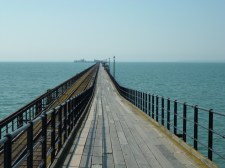
Earlier in the week I was at the other end of the country, in Essex, taking a long walPierk
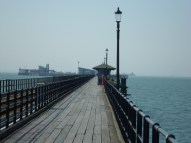
L Pieralong a long pier, (English readers will get the reference to ‘a long walk off a short pier’ – but it might be universal!) where I came across an Enthusiasm of Primary School Children. They were having a nearly-the-end-of term day out doing all sorts of extra-curricular activities, but there was one thing that they all did that made me smile and think: all of them knelt down on the pier floor and peered through the planks to the sea below, squealing with delight.
Swirly SeaAnd yet to see the same sea all they had to do was stand up and look around. But I guess there was no thrill in that; it didn’t hold the same magic as seeing it rushing beneath their feet – maybe subconsciously they thought they were flying. But whatever – they were entranced – looking through the floor, they could see the sea! Their delight was so genuine and so without logic that I too was entranced, but by them. Later that same evening I came across a beautiful wild creature living very happily among us humans. I only managed to get the one (not very good) picture of him before he ran off with a mouthful of food after giving an M&S carrier bag a good ransacking. I feel I need to write a story around him.  Or has someone already done that..?Essex Eddie

And it was the supermarket hand basket.

You wanted it to be the spinning wheel, didn’t you…

Doing Your Research (or not)

Well what a week of downloads it’s been. I have so far managed to download manuals/info on the following topics:

1 The Short Story Tool Kit (with a little help from this fella)
2 How To Change A Tyre
3 Pronouns, Possessive Nouns and Reflexive Pronouns: Where To Put Them And When (that was a riveting read, I can tell you)
4 Why Is My Washing Machine Making That Noise? hints and tips on white goods maintenance
5 Alcohol Use and Misuse (research, obviously)
6 How To Make Yourself Psychic (more research for a book I’m writing. Or rather not writing – spending too much time on…er… research…)
7 Why Your Protagonist Needs An Antagonist
and
8 How To Find An Agent

Which leads me on to one of my favourite/most disliked pastimes: Displacement Activity. As writers, you know as well as I do that we have all fought against/given in to this at some point during our writing hours. Some days the words flow and we sail down the river of creativity, landing at the end of the day on a well-structured and grammatically secure island. Other days we go into battle with our editing sword, slicing and cutting through superfluous adjectives and watch with glee as pointless characters bite the dust, leaving us to survey the scene with a warm feeling of proofread satisfaction. Other days it’s a bit more/less more focussy…where you are inclined to make up words because they sound good but look ridiculous on the page, or fall into the Well of Research where you could possibly drown without realising it.
But wait! Research is good! Research is necessary! I tend to combine my real-life research with real-life activities (rather than the on-line version which eats away the minutes and gorges the hours) – for example, I needed a minor character who at first glance seemed rather unlikely – until I got cut up on a roundabout recently by a white haired driver of later years who blared her horn at me, undertaking me and several other drivers on the left before cutting in front of us all causing a lot of brake action. Mr. Big Car in front of me was not impressed and mouthed something unpleasant at this driver and then accelerated at speed into the four centimetre gap in front of him. Now if I’d met this elderly driver in a cafe or shop would I think ‘Blimey, there’s that bat-sh*t crazy driver who nearly killed us all’ or would I think ‘That elderly lady needs a bit of help with those heavy bags’ (cue Helpful Citizen)? See – unlikely character. She’s got a part in that novel I’m writing. She might be the small character that holds the key to the whole thing, whatever the whole thing turns out to be. Better do some research on that then.


Less Is More

…so they say, and having slaved over a couple of competition entries recently which nudged toward the intimate side of 4,000 words, I was very pleased when my short story in only one hundred and one words was posted on the 101.org site. And here it is! Yeah yeah, I know, only takes 25 seconds to read – took me three weeks and a lesson in car history to get it right. Car history? Is that a thing?

End of blog for today. Less is more, and all that.

It’s Good To Share

And share is what we did, last night in the function room at The Globe pub in Warwick – certainly putting the Fun in to Function. We had all sorts of readings and performances on the subject of Change. Compere and indie author of The Woman Who Never Did, Jenefer Heap ran the evening with aplomb and it was so heartening to see and hear such a variety of writers, all with – literally – a story to tell. We had poetry, prose, non-fiction, performance and song. A-strolling minstrels we.

Poet Nigel Hutchinson read from his book, The Humble Family Interviews, recently published by Cinnamon Press and poet Pauline Brooks gave evocative readings, reminding us that once upon a time train travel was a pleasure. Writer Nick le Mesurier gave us the wonderful story of Isabella and the shriveled member (very Grimm) (and yes, that is member as in member) Poet Gwyneth Box read a mesmerizing poem, translated from Spanish. Writer John Bishop read his thoughtful and unusual piece Born On A Crescent . Most moving of all must have been writer Terri Daneshyar’s piece on Change – that of a lone immigrant child adapting to a new life in the UK.

With a bit of foresight and organisation, you too can run an author evening – a pub, a cafe, a street corner if that’s what takes your fancy – writer and organiser Alex of The Flashers Club in Cheltenham – @otheralexclark – has a few tips for you here

If you’re anywhere near The Gunmakers Arms on the 3rd of July they are hosting an evening of ‘live fiction with a scientific bent’, so lovers of sci-fi and other similar genres better get yourselves over there fast.

If you want to get involved in an author event or start a new one, in the Warwickshire/North Oxfordshire or anywhere near area, drop me line, message, email, DM or pigeon.Collection of Unsettling Display 1.JPG

Torch

‘Take a torch’, my dad said to me once, when I was embarking on whatever exciting activity I was involved with at the time. I must have given him a quizzical look as he elaborated: ‘because then everyone will think you’re in charge.’ In charge of what? I asked, but didn’t get an answer. But I took a torch anyway. Later that day when a friend dropped his front door key between two floorboards (yes that really did happen) I was there, in a flash, to shed some light – literally – on the lost key, enabling repatriation within minutes. But whoa! How cool was I?! I was immediately promoted to The One In Charge, The One Who Deals With Stuff and The One Who Sorts Stuff Out, whether I wanted to be or not. But my dad’s advice stuck with me through the years, and as it turned out I have had need of a torch on many occasions, each time winning the accolades of – amongst others – Clever Girl! (patronising) and You’re So Cool! as well as comments like You Carry A Torch? coupled with a sideways glance which says she’s weird.

But Light! Gotta love a bit of light. Light-hearted. Lightweight. Light At The End Of The Tunnel. Light as Love – “But soft, what light through yonder window breaks?” And for those who believe: Seeing the Light (other lights are available, terms and conditions apply).

So where does this put light in literature? All over the place is my guess. Light and Dark = Forces of Good and Evil; Light-hearted = Fluffy Rom Com; ‘What’s your book about?’ ‘Blood guts and death’ ‘Oh, that’s a bit dark’, = ergo, Not Light.

If you let your protagonist be influenced by metaphorical light, does this help you develop their character? Do we, we readers get to see them in a different… er…light? For example, you may have written your protagonist as a particularly needy, weedy irritating person, but with a zap of metaphorical light, you may enable them – through their thoughts and actions – to expose the failings or hidden agenda in another character, adding depth and layers to both exposition and plot.

As writers we can use day light, candle light, fire light, sun light, moon light, star light, metaphorical light, metaphysical light, comparative light or even no light to highlight (there’s that word again) an emotion, an experience, a person, a scene. Which is a bit like carrying a literary torch around with you. Mary Shelley very powerfully used light-ning to not only bring the monster to life, but (and this is just my take on it) as a metaphor for God’s power and anger at mankind.

Umpteenth proof read/draft of your novel driving you mad?

C’mon. Lighten up.

First Line Dilemma

Hey!! I’ve just won the lottery! £2.3m!

Actually that’s not true. Total fabrication. Didn’t even buy a ticket. But it got your attention, right? Which begs the question, what makes a good opening? Some say jump straight in to the action, which can be good advice if the action is intrinsic to the plot later on in the story – opening in the throes of a bar-room brawl or an A&E department on a Saturday night might indeed be action packed, but if that action has nothing to offer other than as a first-line grabber, you may find that your reader will wonder what the point was. Very unsatisfactory. Here’s a little test for you, although the first one is a bit easy. Each of these opening lines is, in effect, a strap line for the entire book. Discuss.

1 Last night I dreamt I went to Manderley again.

2 Like most people I lived for a long time with my mother and father. My father liked to watch the wrestling, my mother liked to wrestle: it didn’t matter what. She was in the white corner and that was that.

3 Hale knew, before he had been in Brighton three hours, that they meant to murder him.

4 It was a queer, sultry summer, the summer they electrocuted the Rosenbergs, and I didn’t know what I was doing in New York.

5 Far out in the uncharted backwaters of the unfashionable end of the Western Spiral arm of the Galaxy lies a small unregarded yellow sun.

6 It was 7 minutes after midnight. The dog was lying on the grass in the middle of the lawn in front of Mrs Shears’ house. Its eyes were closed.

7 We were somewhere around Barstow on the edge of the desert when the drugs began to take hold.

8 You better not never tell nobody but God.

9 1801 – I have just returned from a visit to my landlord – the solitary neighbour that I shall be troubled with.

10 You will rejoice to hear that no disaster has accompanied the commencement of an enterprise which you have regarded with such evil forebodings.

Answers 1: Rebecca, Daphne du Maurier 2: Oranges Are Not The Only Fruit, Jeanette Winterson 3: Brighton Rock, Graham Greene 4: The Bell Jar, Sylvia Plath 5: The Hitchhiker’s Guide to the Galaxy, Douglas Adams 6: The Curious Incident of the Dog in the Nighttime, Mark Haddon 7: Fear and Loathing in Las Vegas, Hunter S Thompson 8: The Color Purple, Alice Walker 9: Wuthering Heights, Emily Brontë, and number 10 – bit of a challenge this one – Frankenstein, Mary Shelley