

What is it about the word ‘wolf’ that conjures up so much mischief? Hilary Mantel’s book Wolf Hall has, in my humble, one of the best titles for a book ever. Yes I know she didn’t make up the title – who but the Tudors would name their homes so? Houses of the nineteenth and twentieth centuries were bestowed more pastoral names such as Sunnyside, Rose Cottage, Orchard View; no lupine references there to warn any visitor of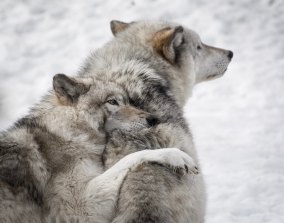 the ambience of the place. Forget entering the lion’s den – the mere assonance of the words wolf and hall tells you all you need to know. In literature, as we know, the wolf has done a marvellous job securing a place in folklore – whether for good or ill – there’s the favourite, little red and all her trials and traumas; that sneaky double-dealer the wolf in sheep’s clothing, Peter and his wolf, which has a sort of nice ending – the wolf doesn’t end up brown bread, but he is wolfnapped and put behind bars in a zoo. Then there’re those house-building pigs and their nuisance neighbour who wanted to puff their properties down, and indeed, thanks to Aesop, the attention-seeking little boy who couldn’t help himself and kept crying ‘wolf!’ until one day there really was a wolf and…well…we all know what happened then, plus any number of other wolfie-related stories, sayings and poems littered through history and literature. ‘Holding the wolf by the ears’ is a great metaphor for things being a bit tricky, and keeping ‘the wolf from the door’ has a delicious medieval ring to it, sounding much better than ‘too much month left at the end of the pay packet’. The most up to date wolf story I found this week (although it may well be old news by the time you’re reading it) is about the young wolf who got himself stuck in a freezing river but thankfully was rescued. Except the rescuers didn’t know what they were rescuing – imagine being in a car with a cold and grumpy wolf across your lap, taking the scenic route to the vet. Dodgy. But it is a heartwarming story, so here it is, courtesy of the BBC.
The wonderful photo above is by Yannick Menard, freely published on Unsplash. Thank you Mr Menard
@yannickmenard
https://www.bbc.co.uk/news/world-europe-47330924
And now a poem by Richard Edwards
taken from
The Thing That Mattered Most: Scottish Poems for Children
edited by Julie Johnstone (SPL/B&W, 2006)
A Wolf In The Park
Is there a wolf,
A wolf in the park,
A wolf who wakes when the night gets dark?
Is there a wolf in the park?
Is there a wolf,
A wolf who creeps
From his hidden den while the city sleeps?
Is there a wolf in the park?
Is there a wolf,
Whose nightly track
Circles the park fence, zigzags back?
Is there a wolf in the park?
Is there a wolf,
Who pads his way
Between the tables of the closed café,
Is there a wolf in the park?
Is there a wolf,
A wolf whose bite
Left those feathers by the pond last night,
Is there a wolf in the park?
Is there a wolf?
No one knows,
But I’ve heard a howl when the full moon glows…
Is there a wolf in the park?

 Jacci Gooding, Author
You must be logged in to post a comment.