Poetry Prose and Other Things

As part of the on-going preparations for next year’s South Warwickshire Literary Festival, this Saturday I’m very much looking forward to hopping over to Rugby library to see and hear the contestants for next year’s Warwickshire Young Poet Laureate. It’s been a while since I attended the event due to you-know-what, so it’ll be good to get back in the audience and hear these excellent poets read their work. The event is being hosted by poet Steve Pottinger and it’ll be good to hear his work too.

On the subject of words, poets and writery things, in an email I received from from the Evesham Festival of Words Director Sue Abblet today, she shared this about the festival and how such events can be an inspiration:

“When the Festival first started we used to run a Junior Short Story Competition.  A regular winner was Iona Mandal who said that our Festival was a huge source of inspiration.  Huge congratulations to Iona who was recently selected as Birmingham Young Poet Laureate (2022 – 2024).” Isn’t that just fantastic? So keep those short story and poetry competitions going – they’re so important.
And not only but also, the Young Poets Network is an online platform for poets under the age of 25 and is packed full of contacts and ideas, and is a great confidence builder for those young poets just starting out. Does the world need more poets I hear you rhyme? Yeah, all the time. Hey – I’m not 24 any more, ok?! 

Going back to short story comps, the marvellous Banbury Writers’ Cafe are hosting a free to enter picture prompt comp which closes at the end of this month. If you zip over to their website you’ll find the four photos to stir your inspiration and all you have to do is tiptappitytip away on your keyboard and get an entry in. Poetry is also accepted. Yeah! I know! 1500 words or less. Guidelines are all on the website. Apparently they’re happy to chuck fifty quid at the winner, thirty at second place and a flat unbendy twenty for third place.  They’re a generous bunch.
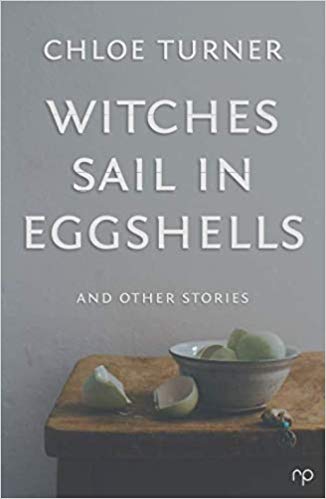
Review – Witches Sail in Eggshells

If you want to write well, you must read, so the saying goes. What a joy then, to be able to read and review Stroud-based writer Chloe Turner’s collection of short stories, Witches Sail in Eggshells.

Witches Sail In Eggshells.jpg

This expertly observed debut collection of short stories reads between the lines of life and explores how we love and lose, then find ourselves and others again.  From an hilarious yet uncomfortable child’s birthday party where the past is laid bare for all to see – yet only seen by some – to the meeting of two women who have loved the same man, to the horror of environmental catastrophe, all stories are told with a melancholic humour that packs a powerful punch.  An example of Turner’s excellent ability to find humour in a sad situation is cleverly explored in Waiting for the Runners in which a mother waiting for her son to finish a cross-country race bumps into the woman who stole her husband. The stooge in the story is Mrs Harris, the PE teacher: Mrs Harris’s Lycra thighs emerged from the shrubbery like purple hams brings brevity to the sadness, the reader having just learned of a terrible sorrow brought upon the narrator years before. Turner does this very well. We feel the pain of each woman – of wife and mistress, of their discomfort and disconnectedness, and yet the story ends with a sigh, a release, that is positive and uplifting. Such juxtaposition of emotions runs through all these stories, often taking the reader by surprise – and that is the magic of Turner’s writing.  In the intriguingly entitled The House With Three Stories That Might Be Five, an unusual but not implausible story unfolds, and this, like the others, has some beautiful observations casually dropped in to the narrative that make you catch your breath. Turner describes Cathy, a group member on a tour, succinctly with a simple line ‘I’ve been alone so long, sometimes I wonder if my reflection might leave me,’ and you feel Cathy’s loneliness like a sting.
The honesty in the writing cuts straight to the core of the story.

In Show Me What You’re Made Of, Turner takes a darker turn, leaving the reader wondering.  Creepiness at it’s best.

There are similar themes running through many of these stories – nature, especially, is given a good chance to be seen, but so too danger and menace, humour, melancholy; many stories have a good helping of stoicism which shines a gentle and up-beat light on a human condition which Chloe Turner captures so well. Insightful, resonant, and emotionally touching in different ways, this collection of stories is well worth a read.

Available from Reflex Press, £8.99

Boo!

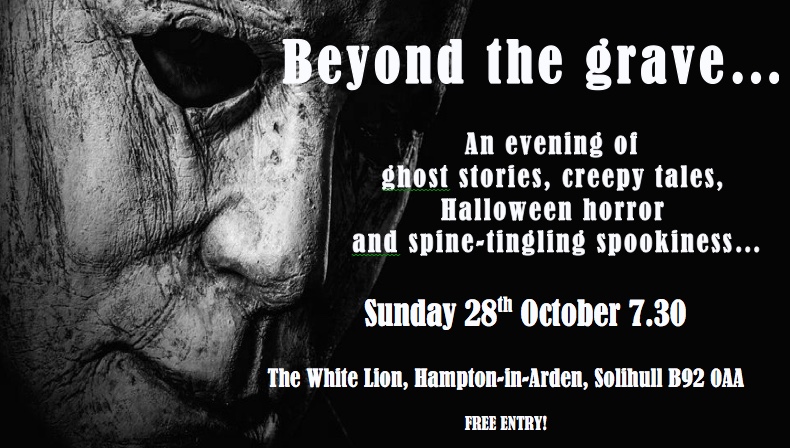
This Sunday myself and other lovers of ghosties and ghoulies and things that go bump in the night are convening at The White Lion pub in Henley in Arden to thrill ourselves senseless with a live lit evening of horror and ghost stories. If you’re in the area, float on by – it’s free entry and it’s a haunted pub; what’s not to like? And if I snap any pictures of phantoms and weirdness, you’ll see them here. My collection of photos of ghostly apparitions seems to be growing, the first one taken during my trip to the wonderful Finland, and some more recently snapped at The Savoy theatre in Monmouth. Freaky stuff.
Beyond The Grave 28th Oct.jpegAnyway, returning to our evolutionary roots of fire-gazing and story-telling, Sunday at The White Lion is bound to be creepy evening – in a good way –  organised by editor and author Pat Spence.

I’ll be reading my ghost story, Channel One Six from my updated Collection of Unsettling Short Stories, which will also be on sale. If you fancy a fun yet spooky night, come along to the White Lion. 

It’s All About The Syntax

During my daily writing endeavours I read a lot of websites, newsletters, blog posts, emails and social media comments under the banner of ‘research’. Consequently I come across some absolute howlers. I received this in an email yesterday and was struck by the architectural aspect of it:

‘…should be reported to the office in a timely manor..’

Now, you can’t blame people for finding spelling difficult, (see my previous blog interview with writer Hugo Kerr) any more than you can blame people for struggling with maths, but sometimes do you think – Get Someone To Check It Before You Send It? Or, if you’ve been asked to read/review the work of an autonomous author, think: (Why Didn’t You) Get Someone To Check It Before You Printed It? If you want your work to work well, there really is no excuse.

Ben-Hershey-550479-Unsplash.jpg
Thank you, Ben Hershey + Unsplash.

A while ago had some short stories copy-edited by two people at the same time just to gauge their different points of view and editing techniques. One comment still stands out today. I had used the word ‘silty’, but the copy editor was sure I meant ‘salty’. I assured him I did not. ‘Was I absolutely sure?’ he asked. I confirmed I was. The other copy editor didn’t comment on this word at all, clearly happy with the word and my use of it. But it threw up an interesting point – would my readers think I meant salty even though I’d written silty? Did it matter? I think it did. It still does. From my point of view as a writer, I want my readers to enjoy my work, not stumble head-first over an unfamiliar word or a familiar word in the wrong place. Control freak? Possibly.

In an email I received last week I noticed that some of the punctuation in this sentence had fallen away – if indeed it was ever there in the first place. I suspect it wasn’t:

‘I have sent this email in edith’s best interest would you suggest this is left for edith to dispose of going forward.’

I don’t really know what this person is saying to me. But it seems rude to ask, somehow. Yes, yes, yes, I’m as guilty as the next writer of missing out or adding an extraneous word to what I thought was a perfectly formed sentence, but when it comes to syntax…ah… now you’re talking. This can take hours to get right, and yet still be wrong.

Below is a statement from a website menu I read earlier today and shared here for your delectation:

… our delicious roast dinners from just £12 each, the meat alternates each week and will be uploaded to Facebook.

I really did not make that up!

Competition Time

Still not in Back to Work mode? Spend a few hours with these little opportunities and see what you come up with. Think of them as the hors d’oeuvres to the main meal of your story writing.

And thank you Unsplash photographers for the free use of the pic

Free To Enter – the Telegraph Online ‘Just Back’ Travel Writing Competition. If you are just back from somewhere slightly more interesting than a bus stop, then the Telegraph Online would like the exciting details in up to 500 words. You can read previous winners on the website. A ‘voyage’ across the Mersey is one of them – proving that you don’t have to write about anywhere exotic to scoop the prize.


Picutre Courtesy of Unsplash.jpg
Picture courtesy of Unsplash

Closing: Monthly. Prize: £200 in your choice of currency.
 Email your entry, of no more than 500 words (with the text in the body of the email), to justback@telegraph.co.uk

Free To Enter
– The Val Wood Prize

2018: Women’s Writes competition,  now open for submissions. This annual freebie from the website of author Valerie Wood is open to anyone over the age of 16 regardless of gender.  This year the contest is celebrating 100 years since married women won the right to vote.  Stories should therefore have a strong female protagonist.  Other than that you are free to write about anything you wish.  Story length 1,500 words Closing: 15.9.18 (5pm). Prizes: £100, £50, £25, £25. 
Details here

Free To Enter – Harvill Secker and Bloody Scotland have joined forces to launch a competition to find a debut crime writer from a BAME (Black Asian Minority Ethnic) background. The winner will have their book published, under the Harvill Secker imprint, in a publishing deal with an advance of £5,000. The winner will also receive perks alongside their publishing contract, including a panel appearance at the Bloody Scotland Festival in 2019 (this year’s dates are 21st-23rd September) and a series of three one-to-one mentoring sessions with Abir Mukherjee.
Closes 9th of September 2018. Details here

Hour of Writes Competition. To enter this new weekly peer-reviewed contest from Manchester, submit a piece of writing of any type you choose running to no more than 2,000 words. There is a different theme every week. Closing: 11pm every Friday. Prize: £50 (usually the minimum – prize increases if more entries are received).
 Entry Fee £3. Details here

Dark Tales Short Story Competition. For horror and speculative fiction – the sort that leaves you afraid to turn out the lights in case something other than a fly is hiding under the bed. Like a Spider, for example. No matter how small. All those legs. And far too many eyes…Anyway… your entry must be limited to 5,000 words. Closing: Monthly. Prize: £100 and publication. Entry Fee £4. Details here

Flash 500 Competition. Write an entire story in just 500 words. Easy peasy. (And you would have practiced with your Telegraph entry, right?) Now in its ninth year, this quarterly open-themed competition has the remaining 2018 closing dates of 30th September and 31st December 2018.
Entry Fee £5 per story or £8 for two. The results will be announced within six weeks of each closing date and the three winning entries each quarter will be published on their website. Details here