New Words for Old

There have been some really good words about recently – new words that is. Not new meanings for old words, but actual new words born into the world. There are some words I’d be happy to see replaced however. Y’know, a bit like a spring clean. Clearing out the dictionary.  For example, normal. It’s judgemental for one thing, and exclusive. If you are not ‘normal’ you are deemed to be ab-normal ergo not good enough. A carrot farmer was sighing this unhappy truth to me last autumn. He had abnormal carrots. But they’re just carrots, I said. Not straight enough, he said. Green leafy bit (that gets cut off and never seen by anyone else) deemed not green or leafy enough. By whom? Carrot Judge? Seemed a strange state of affairs. All the world’s languages (current estimate 7,000!) are chock full with tongue-twisting and diverse lexicons so you’d think that we could do without certain words. No-one would notice, surely?
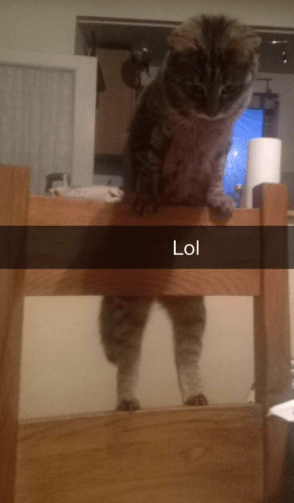
Recently, a friend was laughing hysterically at an on-line photograph of a cat and the text beneath. I interrupted his chortling to ask him where the word meme came from.

“The internet,” he said.LOL.png
“But what does it mean?” I asked.
“Doesn’t mean anything. It’s just funny.”
Hmmmmm…
“It must have come from somewhere,” I persisted.
He gave me a look that said how stupid are you? which I chose to ignore. So, other than to admire pictures of pretty kitties, I too took to the internet and had a little search. I was very surprised to find that the word meme is a very old word indeed, it’s roots belonging to those ancient Greeks. The online Oxford English Dictionary currently defines the word thus:

an element of a culture or system of behaviour passed from one individual to another by imitation or other non-genetic means.
That’ll be the pre-internet definition then, courtesy of one Mr R Dawkins.

and

an image, video, piece of text, etc., typically humorous in nature, that is copied and spread rapidly by Internet users, often with slight variations.  

So, when I pointed out to my colleague that the word meme was not born in the early 2000’s it was fair to say he was so engulfed by disbelief he had to take the rest of the day off.
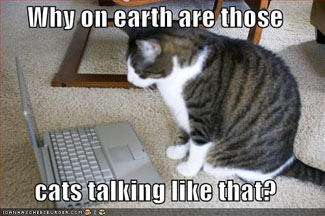
There’s a meme in there somewhere.talking cats.jpg
Anyone Can Write a Book

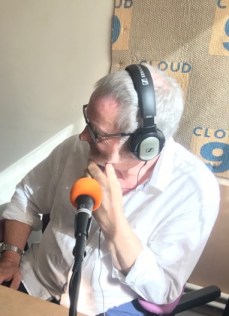
…right? Right! It’s the other bit that’s so hard. I’ve had three emails already this week – and it’s only Monday – asking me about marketing and promotion, those two holy grails (can you have two holy grails?) of independently published book selling. Before we go any further though, this week’s blog isn’t a long list of Dos and Don’ts and Hints and Tips, it is an interview with writer, on-line radio producer and theatre critic Nick Le Mesurier who offers writers a little light in the bewildering darkness of self-promotion.Hard at Work at Stratford Words.jpeg

Nick has two undertakings running concurrently, the writer’s radio platform Stratford Words via on-line radio Welcomb Radio, and a new podcast, Speak, Muse! To start off then Nick, tell us a little more about each…

‘Well, writing is difficult enough in itself: promoting your work is even harder. Both Stratford Words and Speak Muse aim to provide a platform for writers to present their work and to discuss it. Services such as the BBC tend to feature only established artists, and while that provides good material and interesting copy it ignores a lot of other writers who, for various reasons might not have been so lucky, or who are at earlier stages in their careers’.

And how do you go about this? That is to say, how do you get the best from your guests?

‘In each format I try to give subjects a little space to explore their experience and what drives them. Stratford Words has a nice live feel to it but Speak Muse can allow for a bit more space; I also transcribe the Speak Muse interviews so the audience can get a fuller appreciation of what each guests says. So along with providing a positive environment for discussion and reading I try to find some questions that will interest listeners and readers (who I assume are often interested in the writer as much as the written word) and also shows an awareness of what the writer is trying to do.’

The art of asking a good question is quite a hard one to master I would imagine. What inspires the questions you ask of your guests? Is there a role model you work to?

‘I would say my role models for each are radio 4, with a nudge towards radio 3, and The Paris Review interviews. The latter are really the gold standard. I don’t mind trying to be a bit high-brow: in the rush for publicity brows are too easily lowered! And yes, that means I have to do some homework. But it’s not my job to trip up my subjects but to bring the best out of them.’

Yes, I’ve heard it said that some writers, although they may pour their heart and soul in to a novel are quite shy and retiring in person.

‘Indeed. Yet the principles of interviewing a well-known author apply equally to an unknown author or someone just starting out. I’ve had some good interviews with people like poet Ann Alexander whose work I love, and also Paul Budd, whose novel A Material Harvest is worthy of more attention. Then I have Vanessa Berridge talking about her love of the social history of gardening.  Or Amanda Laidler who is not so well known but has a lot of experience working with young actors. Then there are a couple of young authors just starting out on their careers, Natasha Dubalia and Sacha Wood, for example. They’ve some way to go yet, but to be encouraged and taken seriously at this stage could be very helpful to them later on.’

If you would like to know about Nick and his work with authors on Stratford Words and Speak, Muse, please contact him here: nicklemesurier@icloud.com

As Nick says, ‘The truth is that there is an over-supply of writers and not enough listeners and readers for new work. It’s hard to get a reward for the years spent working on one’s writing. Mine might be only a small platform, but it is that at least, I hope.’


Competition Time

Still not in Back to Work mode? Spend a few hours with these little opportunities and see what you come up with. Think of them as the hors d’oeuvres to the main meal of your story writing.

And thank you Unsplash photographers for the free use of the pic

Free To Enter – the Telegraph Online ‘Just Back’ Travel Writing Competition. If you are just back from somewhere slightly more interesting than a bus stop, then the Telegraph Online would like the exciting details in up to 500 words. You can read previous winners on the website. A ‘voyage’ across the Mersey is one of them – proving that you don’t have to write about anywhere exotic to scoop the prize.


Picutre Courtesy of Unsplash.jpg
Picture courtesy of Unsplash

Closing: Monthly. Prize: £200 in your choice of currency.
 Email your entry, of no more than 500 words (with the text in the body of the email), to justback@telegraph.co.uk

Free To Enter
– The Val Wood Prize

2018: Women’s Writes competition,  now open for submissions. This annual freebie from the website of author Valerie Wood is open to anyone over the age of 16 regardless of gender.  This year the contest is celebrating 100 years since married women won the right to vote.  Stories should therefore have a strong female protagonist.  Other than that you are free to write about anything you wish.  Story length 1,500 words Closing: 15.9.18 (5pm). Prizes: £100, £50, £25, £25. 
Details here

Free To Enter – Harvill Secker and Bloody Scotland have joined forces to launch a competition to find a debut crime writer from a BAME (Black Asian Minority Ethnic) background. The winner will have their book published, under the Harvill Secker imprint, in a publishing deal with an advance of £5,000. The winner will also receive perks alongside their publishing contract, including a panel appearance at the Bloody Scotland Festival in 2019 (this year’s dates are 21st-23rd September) and a series of three one-to-one mentoring sessions with Abir Mukherjee.
Closes 9th of September 2018. Details here

Hour of Writes Competition. To enter this new weekly peer-reviewed contest from Manchester, submit a piece of writing of any type you choose running to no more than 2,000 words. There is a different theme every week. Closing: 11pm every Friday. Prize: £50 (usually the minimum – prize increases if more entries are received).
 Entry Fee £3. Details here

Dark Tales Short Story Competition. For horror and speculative fiction – the sort that leaves you afraid to turn out the lights in case something other than a fly is hiding under the bed. Like a Spider, for example. No matter how small. All those legs. And far too many eyes…Anyway… your entry must be limited to 5,000 words. Closing: Monthly. Prize: £100 and publication. Entry Fee £4. Details here

Flash 500 Competition. Write an entire story in just 500 words. Easy peasy. (And you would have practiced with your Telegraph entry, right?) Now in its ninth year, this quarterly open-themed competition has the remaining 2018 closing dates of 30th September and 31st December 2018.
Entry Fee £5 per story or £8 for two. The results will be announced within six weeks of each closing date and the three winning entries each quarter will be published on their website. Details here