
A few days ago – may be it was weeks – you know what us writery types are like – I was very lucky to be involved in the fabulous Words of Love author event run by brilliant author Jenefer Heap. Her Words of.. events (Shakespeare, Winter, Change and most recently Love) have proven a great success, rolling out the talents of many Warwickshire-based writers and poets of all styles and varieties. As is often the way with creative types we started off in one pub and ended up in another. Not that same evening, you understand. We have moved to new premises and now Upstairs at Merchants Wine Bar, Swan Street, Warwick is our new home for such events. The MWB website describes itself as an 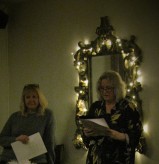
English Restaurant, Gin House, Whisky Den, Cocktail Emporium & generally fantastic place to get a cup of proper English Tea.
Anywhere that has the words Gin, Den and Emporium in the same sentence has to be worth a look. And as you can see, it even has a magical mirror lit from behind with fiery fairy dust. No really. That truly is fiery fairy dust.
If you’ve never been to an author event – call it stand-up if you will, although we like to think of it simply as story telling – do look about for one in your area and go along. And if you can’t find one – make one! It’s a great place to test new work, create new work, or read old work.
As our evening was a love-based cornucopia of hearts and flowers, I thought I’d write a soppy poem. Here it is. It is called
Elements
So hot, the air
stopped me from breathing
my heart
too
paused;
had that just happened?
I couldn’t tell
A rage of heat now burned me raw
and I welcomed the experience
No, no, too much
It was too much
I turned and faced the breeze
that breath of wind that carries memories
and desires half way around the world
and then on further
because there is no end
The wind just keeps on blowing
until
it arrives again
from where it had departed
There is no escape
And this, too, is good
I do not want
to escape
We danced
and flirted; you smiled, laughed nervously
and I, a child again, observed
Is this it? Is this what it’s meant
to feel like?
To be burned and cooled and burned again
so much so that I
become it?
I hope it is
That first flash of fire
dissipates
calms, moves over, lets a gentler state
arrive
Solid, strong, supportive
I am surprised
More so by myself – I did not intend
for this to happen
so fast
But it feels right
As if it should be
And now, that element of earth
feels firm
beneath my feet
Without it, there is nothing
We would fall away
and spin and spin and spin
for ever
We laugh and play
one day blown by the wind, our emotions
scattered
No boundaries for you and I
But then the burning heat returns
The door
made purposefully to slam
does so, loudly
First me, then you
then you again
then me
But never closing
There is always a crack
a slit where light can creep
and usually by dawn
the door is open wide
again
This whirlwind has lasted longer
than half my life
and more than half of yours as well
This hurricane of heat and flame
of solid earth and
breeze that turns so quickly
into a twisting violent tempest
is the esoteric force
enjoyed by some
the lucky ones
while others stand aside
No choice
That day the breeze
blew you
to my door
single,
alone and done with the world
was a good day
It brought fire and air and hot and cold
back into an empty pointless life
And now
in times of transience
when we cannot change events
when everything has been against us
we have navigated those waters
held on tightly to the sides
of our little boat
as we hurtled head-first
down-stream
to whatever awaited at the end
but always
somehow
dragged ourselves half drowned
onto the reassuring earth
again
fire wind water earth
we are these things.
Tag: reading
Read Write Research
Are you struggling with how to get going with your research? Here are a few tried and tested tips that may help you crack on with it. Not all infallible of course, but you have to start somewhere!
1 – and the most immediate and obvious – The Internet! – go anywhere in the world! Meet people, look at photos, read blogs – and this even applies if you’re setting your novel in a fictional town or village that just so happens is similar to the place you live or grew up in, or is perhaps a favourite holiday destination. If you have an idea for a novel, it would be daft not to use the internet – and especially so on a cold wet rainy day. Save the touchy feeling research for when the weather’s better. And sign up for every newsletter going – that way you get find out about free stuff, new stuff, odd stuff.
2 – my favourite – Listen. Or ear-wigg. Or eavesdrop – whatever you want to call it – listen to snippets of conversation and write them down. Anywhere there are people is good for this; in the winter, cafes, supermarkets, cinemas etc. In warmer weather, parks and public spaces. Be alert! And take a notebook and pen. Or dictate – whatever you do, don’t miss the moment. Often random comments can help create a character or even lead to a whole scene you hadn’t even thought about.
3 – Talk. And not always to yourself. Sure, dictate notes into your phone or whatever, but strike up conversation. Some people will give you a wide berth, others will be more than happy to chat. And it’s all research.
4 – Whenever you can, research through reading and observation, both of which are free. Use your library, bookstores and local cafes. In these quiet places you can read to your hearts content. When writing fiction it’s important to read in your genre so that you understand who essentially, you’re writing for. If you want to write crime for example, get ten crime novels from your library, pitch up in a cafe and get scan-reading. If after chapter two of a particular novel you know you don’t like it, make notes as to why – poor use of English? Too much English? Slang? Sentence structure? Knowing how you don’t want to write is great help in defining how you do.
5 – For historical fiction research you have to know your onions because you can absolutely bet your readership will, and they can be very unforgiving if you get it wrong. If you find two conflicting references to the same thing, seek out a third and if you’re still not sure, don’t include it.
6 – Logistics. You must get your logistics right. If you’re following characters a, b and c down a corridor and character d appears from behind a fake palm tree, then the narration immediately has that character following, the reader will want to know how character d suddenly got behind them all without anyone noticing. If you have people on bus seats, make sure the right person stands at the right time for it to make sense in the story.
7- Travel/ing – If you’re writing about a journey on a bus, for example – go on a bus! Feel the seats, smell the smells, see the litter, note the bus driver’s expression or sitting position. All these small details can bring a character to life.
8 – Local Attractions. You don’t have to go globetrotting of course – a trip to the local supermarket can be a deep well of research. Need to take a character to Istanbul or Poland just so they can have something to eat? Check out the international aisle and see what you can buy. Then buy it and take it home and eat it. Experience the taste and flavours. And keep a look out for exhibitions in your locality – museums for example, local art festivals, council-funded displays etc. Much can be found on your doorstep and much of it free.
9 – Getbackto. Write what you need to write and when editing highlight the areas that need clarification through research. Then on a different day, let’s call it A RESEARCH DAY, (snappy huh? yeah I thought so too) you can spend the whole day researching, rather than trying to write and research at the same time and getting so completely distracted that you, literally, lose the plot.
They way you research is personal to you – there’s no right or wrong way. We all learn differently. I know one writer who has different colour pens for each character and when he’s researching something they’d do, he only writes about them in that colour. So do what you will, your way. If you’re new to research it may help to create some questions for your characters to answer to keep you on track. Why doesn’t Edwin like tomato soup, for instance? Does it matter that he doesn’t? It might. Don’t worry about excluding something of course – not all research is relevant and if it’s delivered in clumpy spade-loads, your readers may soon feel they are being told something rather than absorbing it through the narrative and that can be very distracting.
So, done enough research for today? Crack on then!
 Jacci Gooding, Author
You must be logged in to post a comment.