Eyeing-Up The #Competition

And here we go again! Another year of ideas, of writing, editing, networking. From October last year I began entering all sorts of competitions; short story, flash, meet the agent, pitch your novel, win a basket of kittens etc etc.  In the week before Christmas I received a rejection a day, Monday through to Friday. A No Thanks. A Not Today. A what-some-like-to-call Rejection of my work every single day for a week. Fine. Have it your way I thought. But after a quick sulk and an hour on Twitter looking at large cats squashing themselves into small boxes and dogs pretending they hadn’t been caught emptying the kitchen bin I decided that my work hadn’t be rejected, but declined. That made me feel better. And it’s true isn’t it – one competition judge’s decline is another’s accept, so that’s what I’m going into the New Year with – positivity.
There are lots of competitions out there at the moment. Big ones, little ones, short ones, long ones, international and closer to home ones. So let’s get going! Tinsel and tat long gone, let’s get on with the business of boosting your writing and confidence by entering some. Here are my top tips:

1 – and I never thought I’d ever say this – get yourself a spreadsheet and list what you’ve sent, where you’ve sent it, when the results day is and what the process will be – ie winner notification, shortlisters posted on the competition website etc etc. Dull as it may sound, having a spreadsheet will help. Trust me. Seeing how many comps you’ve entered keeps you on track

2 Go for ones with good prizes, not just ‘and you’ll get published on our website’, good as they may be. Go for something really worth writing for, like a decent cash prize, a presentation (ie a chance to network) and possibly publication

3 Try to enter two or three a week

4 It can get expensive so look for some free to enter comps

5 Share the opportunities with others – FB, Twitter, in person. What goes around comes around my friend.

Here’s six of the juiciest I’ve found this week: (but there are loads and loads out there!)

1 The Chipping Norton Festival ChipLit Short Story Comp 2020 – closes 8thFeb

2 Retreat West – The Retreat West Novelette-in-Flash Prize 2020. Word count for this competition is 8000 words. The narrative arc should be made up of standalone flash fiction chapters of up to 500 words each. Deadline May 31st, £10 entry fee https://www.retreatwest.co.uk/novelette-in-flash-prize/

3 The Fiction Desk – Ghost Story (always a favourite) £3 entry fee, deadline 31 January 2020. Theme: Ghosts Across Borders
https://www.thefictiondesk.com/submissions/ghost-stories.php

4 Bath Flash Fiction Award Maximum length is 300 words excluding title https://bathflashfictionaward.com/ ClosesMidnight February 16th 2020

5 The 2020 Bristol Short Story Prize in association with Tangent Books, is open for entries from writers all around the world

6 And if you’re looking to stretch your writerly muscles, why not write for someone else? That no-nonsense gang of writers down west, Writers HQ, are looking for people to write their blog occasionally. Nothing ventured, nothing gained…
https://writershq.co.uk/write-for-us/

In Three Words

Here we are then, in the UK Silly Season. Although it could be argued that we’ve been suffering that particular season since June 2016. But wait. I have always maintained not to get political on this blog, although sometimes it is hard not to rant, rave, scream, stamp and generally be a big mouth about SomethingorOther. So many causes out there to support; so many injustices and hurts to rail against. Where to start, eh? But as I say, No. This is meant to be a writer-related blog although it can be hard sometimes to say anything that a) anyone wants to read, b) that hasn’t been said before or c) isn’t just plain boring. So then dear Reader, what approach shall we take today?

Well, for starters, how about a visit to The Houses of Parliament? Ever been there?


 Let’s play the Three Word Game ie – Describe yourself in 3 words – ‘Witty’ ‘Bold’ and ‘Waggish’ for example – except apply to a recent visit, meeting or coincidence.

So back to the Houses of P. Three Words.
1)Weird
2) Tiny!
3) Perplexing

A Meeting:
1) Chance
2) Surprise
3) Hot

and a recent coincidence
1) Unsettling
2) Profound
3) Bewildering

And now apply the same rules to that short story/flash fiction/novella you’re busy crafting through these summer months. In essence, what are you writing and What Is It About? Use the three point plan to answer yourself. Describe what you’re writing in three words. Then describe what you’ve written in three words. Does it add up to six? If not, maybe go back to the notepad.
Whilst wandering the corridors of power inWestminster yesterday I was hoping the sandwich of inspiration would land in my mouth and fill me with lots of amazing and creative ideas stuffing me to over-full with plans and thoughts for the next blockbuster. All I could come up with was a Steampunk Romance in an alternative universe.
danilo-d-agostino-TmSaH54lLG4-unsplash.jpg

Perhaps I need a holiday.


photo by
Danilo D’Agostino

Meeting Mike Gayle

On Wednesday I was lucky enough to be the in the audience for an evening of author talk with the very open and interesting multi-novellist author Mike Gayle, his editor Nick Sayers of Hodder and Stoughton, hosted by independent book shop Kenilworth Books which is based in Warwickshire, slap bang in the heart of the UK.
If you haven’t been to one yet but get the chance to attend an evening where an author talks about their process, their history, their long journey to publication, then I thoroughly encourage you to go. One of the most useful nuggets we came away with was the need for planning. No, not the sort of planning that involves three cups of coffee, a cuddle with the cat and a wander outside for ‘a bit of fresh air’ with a notebook doing absolutely nothing, but the sort of proper planning that involves – and get this wannabe authors – writing a two line synopsis for every chapter of your book. My friend said to me afterward of a masterpiece she is working on ‘that’ll be why I haven’t finished my book – I have no idea what’s going on.’
I’ve never thought about doing a chapter by chapter synopsis. I’ve done actual planning for an entire novel only to find the end result is nothing like I’d thought – nay planned – it would be. Odd how that happens. One person asked about ‘the muse’; does it ever strike? No, was Mr. Gayle’s definite answer. For muse read procrastination. True. But what if you’re not in the creative zone busy carving out characters that live in a whole new world created by you? Short answer – edit. Stop being all arty farty and get brutal instead. Get out your scalpel and trim trim trim trim. And I don’t mean your beard, my furry faced friend. Amputate your adjectives and ditch those descriptors! Squeeze out the fat and get to the muscle beneath, and when you’ve done that, you may see the bare bones of the story (I’m sensing a theme here…). It’s good to edit. But then of course, you have to know how to. There’s a big difference between changing your mind about something you’ve written ‘I don’t like that bit. I’ll change his jumper to blue’ and proper editing. How about not mentioning the jumper at all? Chekov’s Gun and all that. And that of course is where Nick Sayers’ insight was invaluable. How do you know what even needs editing? someone asked. Well, ‘you just do’, was the answer. Clunky dialogue, confusing/boring/pointless sentences/paragraphs/chapters will stand out to an expert, which is why they are experts at what they do. Midwives, really, helping the author deliver what the author thinks they want to deliver; what they had planned in those two-line chapter by chapter synopses.
And talking of which – I sent off some work to a very well known agency recently:
‘send both synopsis and the first 3000 words of your novel in one document only.’ Well that’s easy enough. I can do that. Edited the work in question, added it to the same document as the pain-stakingly created, written, revised, rewritten 3 page synopsis and pressed send. God they’ll think I’m brilliant.
And then I saw that little teeny weeny bit that said ‘send a synopsis of no more than a page…’

Should have edited properly, shouldn’t I.

Wolf

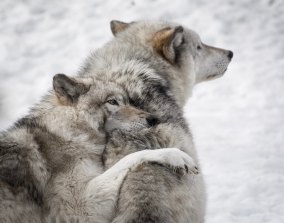
What is it about the word ‘wolf’ that conjures up so much mischief? Hilary Mantel’s book Wolf Hall has, in my humble, one of the best titles for a book ever. Yes I know she didn’t make up the title – who but the Tudors would name their homes so? Houses of the nineteenth and twentieth centuries were bestowed more pastoral names such as Sunnyside, Rose Cottage, Orchard View; no lupine references there to warn any visitor ofyannick-menard-1272925-unsplash the ambience of the place. Forget entering the lion’s den – the mere assonance of the words wolf and hall tells you all you need to know. In literature, as we know, the wolf has done a marvellous job securing a place in folklore – whether for good or ill – there’s the favourite, little red and all her trials and traumas; that sneaky double-dealer the wolf in sheep’s clothing, Peter and his wolf, which has a sort of nice ending – the wolf doesn’t end up brown bread, but he is wolfnapped and put behind bars in a zoo. Then there’re those house-building pigs and their nuisance neighbour who wanted to puff their properties down, and indeed, thanks to Aesop, the attention-seeking little boy who couldn’t help himself and kept crying ‘wolf!’ until one day there really was a wolf and…well…we all know what happened then, plus any number of other wolfie-related stories, sayings and poems littered through history and literature. ‘Holding the wolf by the ears’ is a great metaphor for things being a bit tricky, and keeping ‘the wolf from the door’ has a delicious medieval ring to it, sounding much better than ‘too much month left at the end of the pay packet’. The most up to date wolf story I found this week (although it may well be old news by the time you’re reading it) is about the young wolf who got himself stuck in a freezing river but thankfully was rescued. Except the rescuers didn’t know what they were rescuing – imagine being in a car with a cold and grumpy wolf across your lap, taking the scenic route to the vet. Dodgy. But it is a heartwarming story, so here it is, courtesy of the BBC.

The wonderful photo above is by Yannick Menard, freely published on Unsplash. Thank you Mr Menard
@yannickmenard

https://www.bbc.co.uk/news/world-europe-47330924

And now a poem by Richard Edwards
taken from
The Thing That Mattered Most: Scottish Poems for Children
edited by Julie Johnstone (SPL/B&W, 2006)

A Wolf In The Park

Is there a wolf,
A wolf in the park,
A wolf who wakes when the night gets dark?
Is there a wolf in the park?

Is there a wolf,
A wolf who creeps
From his hidden den while the city sleeps?
Is there a wolf in the park?

Is there a wolf,
Whose nightly track
Circles the park fence, zigzags back?
Is there a wolf in the park?

Is there a wolf,
Who pads his way
Between the tables of the closed café,
Is there a wolf in the park?

Is there a wolf,
A wolf whose bite
Left those feathers by the pond last night,
Is there a wolf in the park?

Is there a wolf?
No one knows,
But I’ve heard a howl when the full moon glows…
Is there a wolf in the park?

New Words for Old

There have been some really good words about recently – new words that is. Not new meanings for old words, but actual new words born into the world. There are some words I’d be happy to see replaced however. Y’know, a bit like a spring clean. Clearing out the dictionary.  For example, normal. It’s judgemental for one thing, and exclusive. If you are not ‘normal’ you are deemed to be ab-normal ergo not good enough. A carrot farmer was sighing this unhappy truth to me last autumn. He had abnormal carrots. But they’re just carrots, I said. Not straight enough, he said. Green leafy bit (that gets cut off and never seen by anyone else) deemed not green or leafy enough. By whom? Carrot Judge? Seemed a strange state of affairs. All the world’s languages (current estimate 7,000!) are chock full with tongue-twisting and diverse lexicons so you’d think that we could do without certain words. No-one would notice, surely?
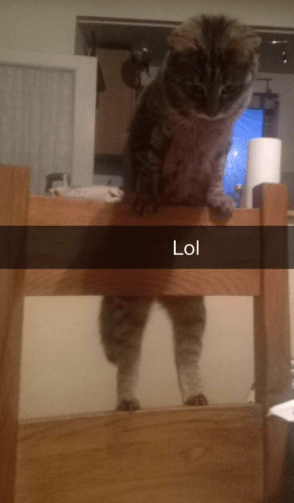
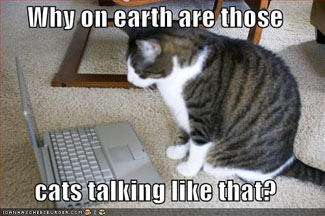
Recently, a friend was laughing hysterically at an on-line photograph of a cat and the text beneath. I interrupted his chortling to ask him where the word meme came from.

“The internet,” he said.LOL.png
“But what does it mean?” I asked.
“Doesn’t mean anything. It’s just funny.”
Hmmmmm…
“It must have come from somewhere,” I persisted.
He gave me a look that said how stupid are you? which I chose to ignore. So, other than to admire pictures of pretty kitties, I too took to the internet and had a little search. I was very surprised to find that the word meme is a very old word indeed, it’s roots belonging to those ancient Greeks. The online Oxford English Dictionary currently defines the word thus:

an element of a culture or system of behaviour passed from one individual to another by imitation or other non-genetic means.
That’ll be the pre-internet definition then, courtesy of one Mr R Dawkins.

and

an image, video, piece of text, etc., typically humorous in nature, that is copied and spread rapidly by Internet users, often with slight variations.  

So, when I pointed out to my colleague that the word meme was not born in the early 2000’s it was fair to say he was so engulfed by disbelief he had to take the rest of the day off.
There’s a meme in there somewhere.talking cats.jpg

Boo!

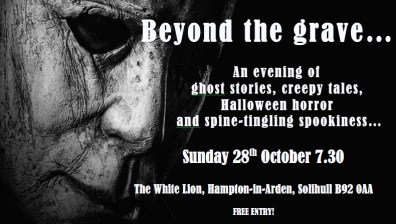
This Sunday myself and other lovers of ghosties and ghoulies and things that go bump in the night are convening at The White Lion pub in Henley in Arden to thrill ourselves senseless with a live lit evening of horror and ghost stories. If you’re in the area, float on by – it’s free entry and it’s a haunted pub; what’s not to like? And if I snap any pictures of phantoms and weirdness, you’ll see them here. My collection of photos of ghostly apparitions seems to be growing, the first one taken during my trip to the wonderful Finland, and some more recently snapped at The Savoy theatre in Monmouth. Freaky stuff.
Beyond The Grave 28th Oct.jpegAnyway, returning to our evolutionary roots of fire-gazing and story-telling, Sunday at The White Lion is bound to be creepy evening – in a good way –  organised by editor and author Pat Spence.

I’ll be reading my ghost story, Channel One Six from my updated Collection of Unsettling Short Stories, which will also be on sale. If you fancy a fun yet spooky night, come along to the White Lion.